Views: 0 Author: Site Editor Publish Time: 2026-05-30 Origin: Site


A premium workstation frequently requires a significant investment. Prices often range from $2,000 to over $10,000. Decision-makers face a crucial question here. The choice is never just about aesthetics. You must decide whether the functional, psychological, and durability returns justify the capital expenditure. Standard office desks often lack essential structural integrity. They struggle to support multiple heavy monitors. They usually fail to conceal extensive wiring systems. Furthermore, standard models do not convey the necessary authority in client-facing environments. You need a workstation tailored for high-stakes leadership. This guide breaks down the core evaluation criteria for premium workstations. We explore everything from material science to ergonomic integration. You will understand base structures, surface materials, and smart tech features. We aim to help you determine if upgrading your primary workspace is the right move for your corporate or home office.
True value lies in stability and scale: Premium desks offer exceptional load-bearing capacities (often exceeding 500 lbs) and expansive surface areas (60–72 inches wide) to organize complex workflows.
Materiality dictates maintenance and lifespan: The choice between solid wood, high-grade veneers, and sintered stone impacts not just the "Buy It For Life" potential, but also the physical logistics of moving it.
Ergonomics is now a luxury standard: A modern CEO desk integrates health-focused features like dual-motor sit-stand capabilities without sacrificing traditional executive aesthetics.
The psychological ROI is measurable: Proper storage and cable management significantly reduce mental clutter, directly impacting focus and decision-making quality.
In client-facing scenarios, the workspace serves as the anchor of first impressions. A luxury boss desk visually communicates stability, authority, and success. Clients subconsciously evaluate your competence based on your environment. Heavy, well-crafted furniture instantly projects reliability. It establishes an atmosphere of trust before you even speak to a guest. You project an image of permanence and control.
Premium workstations feature integrated storage systems. You will often find locking lateral files and hidden compartments. These features remove physical clutter from your primary workspace. Organizing current projects separately from reference materials improves workflow efficiency. It also significantly reduces mental stress. Cognitive load decreases when your eyes are not constantly processing visual noise. A clean surface allows for sharper focus during deep work sessions.
We can compare this upgrade to wearing a bespoke suit. Upgrading your primary workspace has a proven psychological effect. It increases your confidence and internal drive. This psychological boost is especially critical in high-demand remote work environments. High-quality executive suite furniture sets a professional boundary at home. It signals to your brain when it is time to perform. You separate your living space from your working space effectively, maintaining better daily discipline.
Surface aesthetics matter, but core materials dictate lifespan. Buyers often choose between solid wood and premium veneers. Solid wood options like mahogany, oak, and burl wood offer unmatched longevity. They provide a timeless gravitas to any room. Real wood ages beautifully, developing a unique patina over decades. However, you must plan carefully. Extreme weight is a primary factor. Solid wood models can easily reach 300 to 600 lbs. You cannot move these pieces casually without professional assistance.
Premium veneers deliver the polish of real wood at a lighter weight. Manufacturers apply thin slices of real wood over stable core boards. This allows for more modern, transitional designs. It also prevents warping over time in humid environments. Veneers offer excellent durability if properly maintained. You must avoid harsh chemical cleaners to protect the topcoat.
Modern industrial surfaces cater to tech-forward aesthetics. Sintered stone, tempered glass, and aluminum frames dominate this category. Stone offers extreme scratch resistance against everyday wear. You can place hot coffee mugs directly on it without damage. Glass creates visual transparency, making smaller rooms feel expansive.
Evaluate the undercarriage before purchasing. Look for heavy-duty Trestle, Pedestal, or Sled bases. Ensure the frame meets ANSI/BIFMA X5.5 standards for lateral stability. This eliminates frustrating keyboard bounce during heavy typing. Cheap frames wobble under pressure, but luxury frames remain perfectly rigid.
Material Type | Durability Profile | Weight Consideration | Best Use Case |
|---|---|---|---|
Solid Wood | Generational lifespan, develops natural patina | Extremely heavy (300-600 lbs) | Traditional private offices |
Premium Veneer | High durability, resists humidity warping | Moderate weight | Transitional and modern spaces |
Sintered Stone | Extreme scratch and heat resistance | Heavy top, usually requires steel frame | Tech-forward, minimalist environments |
Tempered Glass | Easy to clean, elegant transparency | Moderate weight, requires careful handling | Compact executive suites |
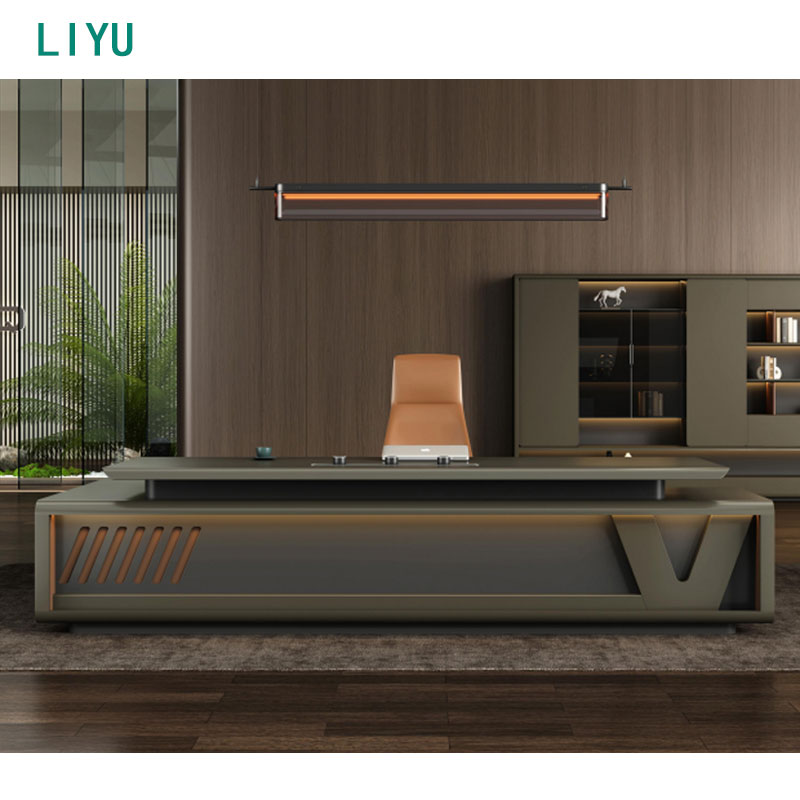
The classic rectangular design remains highly popular across industries. A bow-front design curves outward toward the guest. It is the standard for high-traffic, client-facing roles. The curve offers a welcoming overhang for guest seating during meetings. This simple design choice makes visitors feel accommodated and respected.
L-shaped and U-shaped configurations are ideal for multi-tasking leaders. They allow for distinct zoning within the office. You can designate a primary computer workstation on one side. The other side serves as a clean, paper-based meeting area. This separation prevents digital distractions during face-to-face conversations. You can pivot seamlessly between drafting emails and reviewing physical blueprints.
The peninsula shape perfectly suits private offices. It functions beautifully where impromptu, small-team collaborations are frequent. Users can comfortably sit on three sides of the peninsula extension. It breaks down the traditional barrier between manager and employee. You foster a more collaborative environment instantly.
Keep sizing heuristics in mind during your search. A true high-end office desk should be 60 to 72 inches wide. Depth should range from 30 to 36 inches. Always leave a minimum of 36 inches of clearance on the user side. This ensures proper chair mobility. Furthermore, allow 3 to 4 feet of clearance on the guest side. Proper spacing prevents the room from feeling cramped and unprofessional.
Today's luxury market blends traditional aesthetics seamlessly with modern needs. Manufacturers now incorporate advanced sit-stand functionality into elegant designs. A modern CEO desk lets you prioritize health without sacrificing style. We recommend incorporating the Cornell University "20-8-2" rule into your routine. You sit for 20 minutes, stand for 8 minutes, and move for 2 minutes. This framework reduces the negative impacts of prolonged sitting.
Privacy meets movement in these premium designs. Height-adjustable frames must feature synchronized modesty panels. These panels rise and fall seamlessly with the desktop. They protect your privacy in open or glass-walled corporate offices. Visitors will not see exposed wires or your legs while you stand.
Tech-ready infrastructure defines the modern workspace. Evaluate concealed wire management systems carefully. Ensure built-in cable trays accommodate 25 to 30 centimeters of slack. This extra length is mandatory for height-adjustable models to move freely. A snagged wire can damage expensive electronics instantly.
Look for built-in wireless charging pads. Flush-mounted USB and power hubs keep cords out of sight. Anti-collision gyroscopic sensors are also essential. They protect your investment from hitting underlying cabinets during adjustment. The motors will automatically reverse if they detect an obstacle, saving both the desk and the cabinet.
Discreet Ergonomics: Dual-motor lifting columns hidden inside solid wood or metal legs.
Synchronized Modesty Panels: Privacy shields that articulate with the desk movement.
Smart Wire Management: Deep cable trays supporting multiple monitor power blocks.
Anti-Collision Sensors: Gyroscopic protection against physical obstructions.
Entry-level models typically cost under $1,000. They utilize high-density laminates and standard dimensions. Buyers receive 1 to 3-year warranties and must perform self-assembly. These models work well for budget-conscious home offices. However, they lack generational durability. Common mistakes include expecting these desks to support heavy multi-monitor setups without sagging.
Mid-range professional models range from $1,000 to $2,000. They introduce authentic wood veneers and reliable dual-motor standing capabilities. You will find basic L-shape or U-shape options in this tier. Warranties generally cover 5 to 7 years. You get a solid balance of aesthetics and modern functionality without paying for bespoke customization.
True luxury and bespoke models cost between $2,000 and $10,000+. They offer custom dimensions and premium solid hardwoods or stone. You might find exquisite leather inlays on the surface. Heavy-duty load capacities often reach up to 540 lbs. Buyers enjoy 10+ year warranties and comprehensive white-glove delivery services. You pay for flawless craftsmanship and seamless technical integration.
Pricing Tier | Expected Price Range | Key Features & Materials | Warranty Expectation |
|---|---|---|---|
Entry-Level Executive | Under $1,000 | Laminates, standard sizes, self-assembly | 1 to 3 Years |
Mid-Range Professional | $1,000 - $2,000 | Wood veneers, dual-motor lifts, L/U shapes | 5 to 7 Years |
True Luxury & Bespoke | $2,000 - $10,000+ | Solid wood/stone, leather inlays, white-glove delivery | 10+ Years |
The logistics trap catches many unwary buyers during delivery. You must measure all doorframes, stairwells, and elevator capacities beforehand. A 400 lb solid wood desk is notoriously difficult to relocate. Professional movers are often required for simple room transfers. We highly advise against buying a massive desk if you plan to move offices soon. Measure carefully to avoid expensive restocking fees.
Corporate procurement teams face unique considerations. Buyers should evaluate sustainable materials to meet internal ESG goals. Look for FSC-certified woods and recycled steel frames. Consider bulk customizability for corporate executive suites. Matching brand colors and logos ensures visual uniformity across departments. This creates a cohesive corporate identity that impresses visiting stakeholders.
Never purchase without evaluating after-sales support. You must verify the warranty length on electronic parts. This is critical for dual-motor standing frames. Check the availability of replacement parts in your region. Assess the speed of customer service response before making a final commitment.
To avoid common procurement mistakes, follow this implementation checklist:
Measure all spatial constraints, including turning radii in hallways and elevators.
Confirm ESG certifications if purchasing for a large corporate headquarters.
Verify the electronic component warranty specifically, as it often differs from the frame warranty.
Test customer service responsiveness through a preliminary email or phone call.
Final Verdict: A luxury executive desk is not merely an ornamental purchase. It is a highly functional command center. Your choice dictates daily workflow efficiency and professional perception. Quality materials, structural rigidity, and integrated tech elevate your daily experience.
Next Steps: Begin by mapping your office footprint accurately. Establish a firm requirement for tech integration versus traditional physical storage. Finally, match the expected material weight to your long-term mobility plans. You can then confidently select a model that supports your leadership role.
A: Most range from 60 to 72 inches in width and 30 to 36 inches in depth. This sizing provides ample room for dual monitors, physical documents, and adequate workspace without feeling cluttered.
A: Premium models utilize heavy-duty trapezoidal or X-leg frames. They adhere to strict BIFMA standards for lateral stability. This robust construction eliminates the frustrating "wobble" common in cheaper standing desks.
A: A modesty panel is a shield attached to the front of the desk. It obscures the user's legs from view. It is highly recommended for outward-facing desks in corporate environments to maintain professional privacy.