
Views: 0 Author: Site Editor Publish Time: 2026-10-14 Origin: Site


The short answer. Four material families cover the executive desk market: solid wood, natural wood veneer on engineered board, laminate/melamine (HPL), and metal-frame hybrids. Solid wood carries the premium story but moves with humidity; veneer gives the real-wood look with better stability and is the volume workhorse; laminate wins on commercial durability per dollar; steel usually appears as frames and legs rather than whole desktops. Check emission grades (E1 as the baseline, E0 and CARB Phase 2 for strict markets), match the material to your climate, and lock the finish with a physical swatch before production.
A wood-grain executive desk built on engineered board: the grain comes from the surface layer, while the stability comes from what is underneath. That division of labor is the whole subject of this guide.
Material decides more than looks. It sets the price band your market will accept, how the desk survives a Gulf summer or a Russian winter, which documents your compliance officers will ask for, and whether the re-order matches the first container. This guide is written for buyers who sell into material-sensitive markets: the humid Gulf and Southeast Asia, dry centrally-heated interiors across Russia and northern China, and regulated European and American markets where emission paperwork is part of the tender.
One honest note before the comparisons: most executive desks at the commercial end are not any single material. A typical factory specification, Liyu Furniture's line included, is an E1 low-emission engineered board core with an HPL, melamine, or natural wood veneer surface, powder-coated steel where the design needs slim profiles, and soft-close hardware throughout. The real question is not "which material" but "which surface on which core, with which documents", and the five steps below answer exactly that.
Cost, durability, looks, and repairability pull in different directions. Here is the comparison with the details buyers actually argue about:
Aspect | Solid wood | Natural veneer on engineered board | Laminate / melamine (HPL) | Metal / steel-frame hybrid |
Cost tier | Highest | Mid-to-high | Mid | Varies by design |
Durability | Good but moves with humidity; species matters | Stable core; lifespan set by veneer thickness and edge banding | Best scratch/stain resistance per dollar | Frames are strong; surfaces still board-based |
Look | Authentic grain, one of a kind | Real wood surface, grain-matched across a batch | Consistent, huge decal range; cheap versions look flat | Slim, modern, industrial |
Repairability | Sandable and refinishable | Hard to repair deep damage; edge banding can be re-glued | Not repairable, but hard to damage | Paint chips are touchable |
Batch color risk | Species and cutting vary naturally | Controlled with grain matching and swatch locking | Very low (printed pattern) | Powder coat is consistent |
Weight | Heavy | Moderate | Moderate | Lightest frames, easier installs |
Two practical readings of that table. If you are buying executive office furniture, solid wood for a premium line, expect to pay for drying quality, not just species; badly dried solid wood cracks in dry climates and warps in humid ones, which is why the solid-wood tier serves stable-climate premium markets best. And when a catalog says "executive metal desk", look closely: in this segment steel almost always appears as frames, legs, and legs-plus-modesty-panel structures carrying a board or laminate top. Full metal desktops are rare because they are heavy, noisy, and cold to the touch. The steel-frame hybrid is a genuine third way: metal gives you the slim industrial profile, the surface material still decides the feel and the documents.

A melamine wood-grain surface on an L-shaped layout: printed grain keeps every panel in the batch visually identical, which dealers rely on for re-orders.
Veneer is where most of the market's confusion lives, so here is the plain-language version. Veneer is a thin slice of real wood glued onto a stable engineered-board core. Natural veneer is sliced straight from the log, so every sheet carries the character of the tree it came from; skilled factories sequence the sheets so the grain flows across the desktop. Engineered veneer (sometimes called recon or tech veneer) is made by re-slicing dyed and laminated wood blocks, which produces a repeatable, uniform grain that prints and dyes accept more predictably.
Each route has a buyer profile. Natural veneer sells the story: "this grain exists exactly once", which suits premium executive ranges where slight variation reads as authenticity. Engineered veneer suits programs where ten offices must look identical and re-orders must match, because the grain repeat is controlled at the factory. Both sit on the same engineered core and both get the same edge treatment, which brings up the part that actually decides lifespan: edge banding.
The desktop surface is tough; the edges are where moisture gets in. Ask any supplier three questions: What is the edge banding material (ABS, PVC, or veneer strip)? How is it applied (hot-melt PUR adhesive holds better in humid climates than standard EVA)? Is the banding flush-trimmed and sealed at the corners? A well-banded melamine desk will outlive a badly banded veneer desk in coastal Southeast Asia every time. Veneer thickness matters too: thicker slices can be lightly sanded and refinished once; paper-thin ones cannot.
Formaldehyde emissions from engineered boards are the compliance topic that appears in tenders, and the vocabulary is simpler than it looks:
Standard | What it is | Where it matters |
E1 | Chinese/European emission grade for engineered boards; the commercial baseline | Most markets; Liyu Furniture's standard board specification |
E0 | A stricter informal grade (lower emission than E1), common in China and Japan-influenced specs | Premium and health-sensitive projects; availability varies by board supplier |
CARB Phase 2 | California Air Resources Board regulation for composite wood products; the strict benchmark in North America | US-bound programs; ask for the board supplier's CARB documentation |
UL GREENGUARD | Third-party indoor air quality certification program | Often named in corporate and government tenders |
How to use this in a purchase order: name the grade you require in the specification, and require test reports against it. Reputable manufacturers provide board-grade reports on request even when certificates are not printed in the catalog; what you should not accept is a verbal "yes, it's E1" with nothing behind it. One caution from the field: claims like "E0-certified" deserve the same document check as any other claim, because the grade depends on the board batch, not the desk model. And if your market requires wood-origin documentation, ask how the factory handles sourcing certificates at quotation stage; treatment varies by market and is settled per order, not assumed.
The same desk lives differently in different cities. Four market profiles cover most B2B programs:
Market / climate | What stresses a desk | Material guidance |
Gulf and coastal Southeast Asia (hot, humid) | Moisture at edges; swelling at joints | Prioritize edge banding quality and sealed cores over the decorative layer; HPL and well-banded veneer both work |
Russia, northern China, Canada (dry, centrally heated winters) | Shrinking boards, cracking solid wood | Well-made veneer on stable engineered board usually beats low-cost solid wood; avoid budget solid wood entirely |
Temperate Western Europe | Balanced, compliance-heavy | Any surface works; emission documents (E1 minimum, CARB/GREENGUARD named in tenders) decide the sale |
North America | Compliance plus style range | CARB Phase 2 documentation for boards; veneer and laminate both mainstream |
Two climate details worth knowing even if you buy nowhere near them. High humidity attacks edges first, which is why the edge banding questions in Step 2 matter more in the Gulf than the surface brand. And dry heat attacks joints and solid panels: in Moscow in February, an office at 24°C with 20% humidity is a harsher test than a tropical one, and it is the reason experienced Russia-bound buyers often specify veneer over budget solid wood.

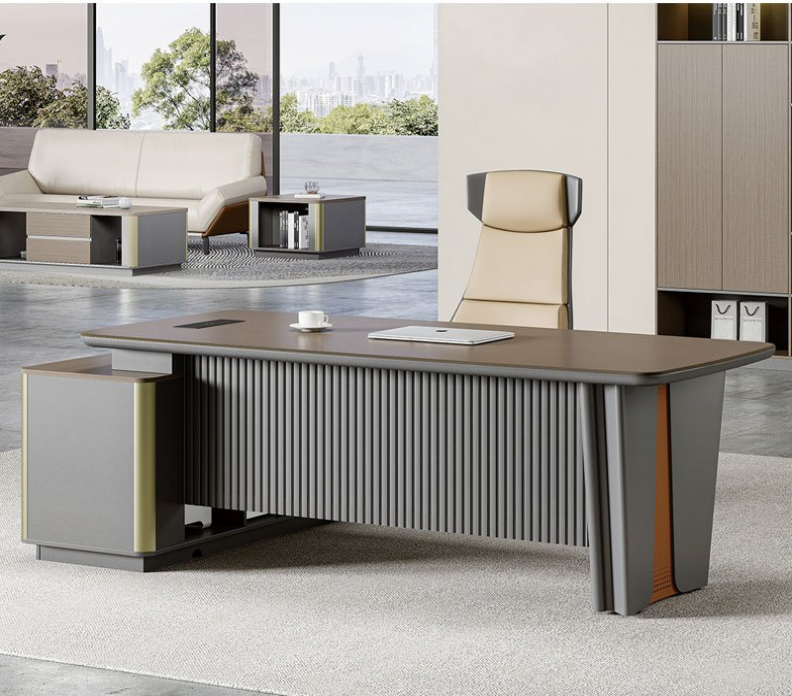
A steel-frame hybrid: metal carries the slim sculptural legs while the lacquered board carries the work surface. The steel solves the profile; the surface still decides the documents.
Materials go wrong at order time, not at factory time. Before confirming any executive desk order, put these seven items in the specification and make each one answerable in writing:
# | Specification item | What "locked" looks like |
1 | Board core and grade | "E1 low-emission particle board" (or your required grade) named on the order, report reference attached |
2 | Surface type | HPL, melamine, or natural/engineered veneer named per panel group |
3 | Finish color | Physical swatch approved and kept by both sides; digital photos are not a color standard |
4 | Color matching system | RAL or Pantone reference for painted/steel parts, so re-orders match |
5 | Edge banding | Material and adhesive type named; corner sealing confirmed |
6 | Hardware | Slide, hinge, and lock grades per model; soft-close named where fitted |
7 | Batch consistency | Written commitment that re-orders match the approved swatch set |
Item 3 and item 7 travel together, and they are the two that protect a dealer's business: a swatch set approved today is the only reliable reference for the container you order next year. Factories that run a proper swatch-locking process will agree to this without hesitation; hesitation is itself useful information.

A lacquer-finish desk with a locking credenza: painted surfaces hold deep, even color across a batch, and the paint system pairs naturally with RAL-referenced color locking.
Which executive desk wood type is most durable?
For the surface layer, durability ranks roughly: HPL/laminate first for scratch and stain resistance, then well-banded natural veneer, then solid wood, which is durable but climate-sensitive. Structure matters as much as surface: an E1 engineered core with quality edge banding outlasts a cheap solid-wood top in most commercial settings.
Is solid wood worth it for executive office furniture?
Solid wood executive office furniture earns its premium in two cases: markets that value the authentic-grain story, and stable climates where movement is limited. In dry heated or humid coastal interiors, pieces built on engineered board with natural veneer usually serve longer for the money, because the stable core handles what solid wood cannot.
Are executive metal desks made entirely of metal?
Rarely at the executive level. "Executive metal desk" normally means a steel-frame hybrid: powder-coated steel frames and legs carrying a board, veneer, or laminate top. Full metal desktops are heavy, noisy, and unpleasant to touch, so steel appears where it adds value: slim profiles, industrial style, and strength.
What is the difference between E1, E0, and CARB Phase 2?
E1 is the commercial baseline emission grade for engineered boards in the Chinese and European systems. E0 is a stricter grade with lower emissions, common in Asian specifications. CARB Phase 2 is California's binding regulation for composite wood and the benchmark in North American tenders. Name the grade in your purchase order and require the matching test report.
What material should I choose for a humid climate?
Prioritize edge banding and sealed edges over the decorative layer: an HPL or melamine surface with ABS edge banding and moisture-resistant adhesive, on a sealed engineered core. Natural veneer works too when the banding is right. Budget solid wood is the riskiest choice in humid heat.
What materials does Liyu Furniture use for executive desks?
The current line combines E1 low-emission engineered board with HPL, melamine, or natural wood veneer surfaces, powder-coated steel frames, soft-close hardware, and matte, textured, or woodgrain finishes selectable by swatch. Board-grade test reports are available on request, and finishes are locked by physical swatch sets for batch consistency.
· Comparing surfaces on real models? Browse the executive desk wood range: panel, veneer and wood-grain finishes side by side.
· Need the full catalog context before picking a finish? Start from the executive desk collection and filter by style and size.
· Custom finish programs (RAL/Pantone matching, swatch locking) run through the customization process, or request a quote with your target market in mind.
Liyu Furniture is an office furniture manufacturer founded in 2007 in Lecong, Shunde (Foshan), Guangdong, in China's furniture manufacturing hub. Research, development, production, and sales run under one roof, and the catalog covers executive desks and tables, executive chairs, conference tables, file cabinets, office sofas, workstations and panels, and reception desks. OEM and ODM cooperation is welcome: production starts after drawings and samples are confirmed, and quotes are provided per model and specification.


