
Views: 300 Author: Site Editor Publish Time: 2026-10-14 Origin: Site


The short answer. In a room of 10 m² or less, a 140–160 cm straight executive desk against a wall, or a compact L-shaped corner desk, fits with proper chair clearance; rooms of 10–15 m² take a 160–180 cm desk with a side cabinet; larger rooms accept full L-shaped or hutch configurations. Home versions of executive office desks for home use differ from commercial ones in three ways: smaller standard widths, flat-pack packaging with self-assembly, and lighter, warmer finishes. Complete the setup with warm layered lighting, desktop power within reach, and storage in three layers, then pick a configuration tier (starter, core or executive) instead of shopping model by model.

A home-scale executive desk: lighter finishes, softer lines and a mobile pedestal instead of a fixed credenza. Everything about home programs differs from the commercial tier, starting with the room.
An executive desk in a home works harder than one in a corporate tower. It shares the room with family life, it gets assembled by one person with an Allen key, and it has to look like it belongs in a place where people also live. This guide is for three readers: professionals setting up a serious home office, SOHO owners whose desk doubles as a client-facing surface, and e-commerce sellers building home-office categories who need to know what actually ships well.
The factory view matters here more than anywhere else in the furniture journey. Home programs live or die on packaging, assembly and finish choices as much as on the desk itself, and the checklists below come from what manufacturers (Liyu Furniture among them) actually build for this segment.
Start with the room, because it eliminates options faster than any catalog. For a small executive desk in a tight room, the arithmetic from office planning translates directly to the home (chair zone 1100 mm behind the desk, walkway 800 mm, no visitor zone needed at home):
Room size | Recommended desk | Layout that works |
Up to 10 m² | 140–160 cm straight, or compact corner desk (120–160 cm) | Desk against a wall; guest chair only if the room is at the top of the band |
10–15 m² | 160–180 cm straight or small L-shaped | Desk + side cabinet on the adjacent wall |
15 m² and up | 180–220 cm, L-shaped with return, or desk plus hutch | Corner configuration with the return carrying storage |
Planning estimates for a desk against a wall; L-shaped layouts add the return footprint. Confirm available sizes per model.
The corner layout deserves its own word. An executive corner desk, in practice a compact L-shaped unit turned into the room's corner, is usually the best small-room answer, because it converts two walls into work surface, puts the user facing into the room rather than at a wall, and absorbs storage into the return. In a 3 × 3 m room, a 150 cm corner unit plus chair clears the arithmetic; a 180 cm straight desk plus a separate cabinet usually does not.
Large home offices (a spare room, a converted garage, a garden studio) unlock the full executive tier: 180–220 cm tops, returns with drawers, even a hutch over the desk. The constraint stops being floor area and becomes visual weight: a 2.2 m dark executive run can overwhelm a 12 m² bedroom-office, so lighter finishes earn their keep here.

A dedicated home office large enough for the full executive tier: L-shaped return with open shelving, power at the desktop, and the chair pulled into the room rather than pinned to a wall.
Executive office desks for home are a separate product line at most factories, not a smaller copy of the commercial range. The differences that matter to buyers and sellers:
Aspect | Home office line | Commercial executive line |
Standard widths | Compact band, roughly 120–180 cm | 160–240 cm, wider on request |
Packaging | Flat-pack cartons, retail-friendly, courier-shippable | Larger cartons, palletized freight |
Assembly | Self-assembly with instructions and video | Professional install, on-site service |
Finishes | Lighter woods, whites and warm grays | Deep executive tones, veneer programs |
Storage emphasis | Mobile pedestals, compact hutches | Fixed credenzas, returns, full storage walls |
Feature emphasis | Cable management, USB power, easy-clean tops | Locks, large drawers, guest seating |
Two of these differences drive cost and logistics more than the rest. Flat-pack packaging is what makes a home-office desk shippable by courier instead of freight forwarder, which changes the entire landed-cost math for e-commerce sellers. And self-assembly quality is a review-score topic: cam-lock systems, pre-drilled accuracy and included tools decide whether the buyer's first hour with your product is pleasant or profane. Confirm both per model with the factory; home-line specifications are model-specific, and the compact band below 160 cm varies more than the commercial range does.

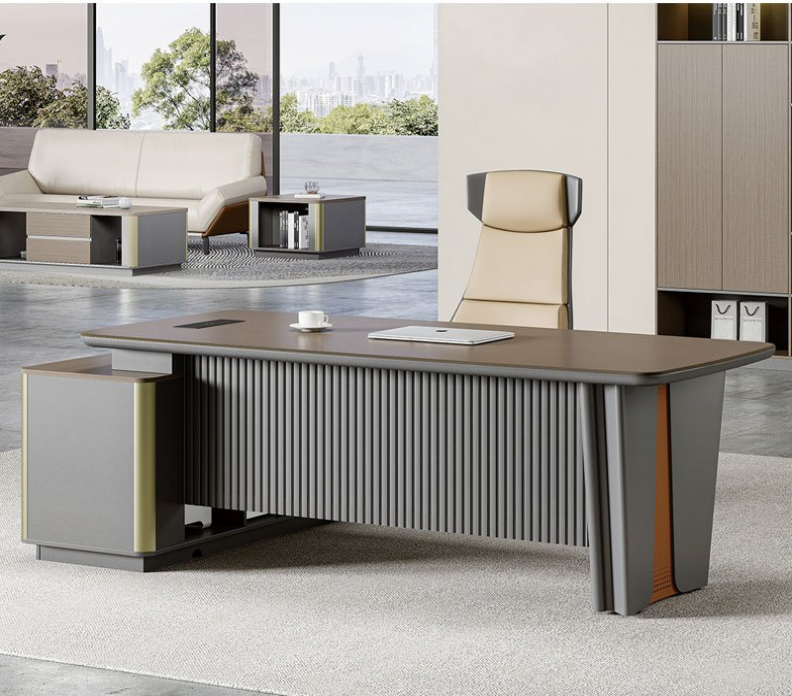
The commercial tier for contrast: fixed credenza, locking storage and a deeper footprint. Knowing where the commercial line starts is what makes the home line sellable on its own terms.
The desk is half the setup. The other half is the three systems around it, and this is the checklist to run before the desk arrives:
System | What to include | Why it matters at home |
Lighting | Warm layered light: 2700–3000 K ceiling or floor ambient, a task lamp, and backlighting on shelves if fitted | Home offices double as evening rooms; one cool ceiling panel makes video calls look clinical |
Power | Desktop USB-A/C module or grommet socket, a cable tray under the top, one outlet per device zone | Home rooms have home wiring; desktop power stops the crawl-behind-the-desk ritual |
Storage | Three layers: daily items in a mobile pedestal, documents in a side cabinet or hutch, display/reference on open shelving | Three layers keep the desktop clear, which is what makes a small room feel executive |
On air quality: home offices sit inside living space, so emission grades matter more than in a ventilated corporate floor. E1 board grade is the baseline to specify, stricter grades where the market demands them, and UL GREENGUARD is the certification name that tends to appear in home-furniture specifications; ask suppliers for the board documentation rather than assuming. The ergonomics rules carry over from the office guide unchanged: OSHA's guidance on seating, monitor height and movement applies at home exactly as it does at work, and the home office has no facilities team to fix it later.
Storage deserves one more paragraph, because it is where home and commercial programs genuinely diverge. The commercial answer to storage is a fixed credenza; the home answer is a hutch: an upper cabinet unit that sits on or behind the desk, adding display, file and closed storage without new floor space. For small rooms the hutch is often the difference between a tidy office and a cluttered one, which is why home-office ranges usually offer one as a matched module.
The hutch answer: display, file and closed storage stacked over the worksurface, adding capacity without adding floor area, the standard move for home offices under 10 m².
Budget conversations go better as configuration tiers, because component lists travel across currencies and price lists do not. Any supplier can quote all three tiers per model; what changes between them is size, storage and finish, not exotic technology:
Tier | Components | Fits | Upgrade path |
Starter | 140–160 cm straight desk, mobile pedestal, ergonomic task chair, task lamp | Spare-corner offices, first home programs, e-commerce entry SKUs | Add fixed cabinet, then swap to Core desktop |
Core | 160–180 cm desk, fixed side cabinet, ergonomic executive chair, USB power module, hutch optional | Full-time work-from-home, SOHO with occasional clients | Add hutch and matching shelving, then extend to Executive |
Executive | 180–220 cm desk with return or hutch, matched chair and credenza, rail power or smart features | Dedicated executive rooms, client-facing SOHO, showroom corners | Finish-program upgrades (veneer, color lock) |
For e-commerce sellers, Starter and Core are the volume tiers: flat-pack friendly, courier-shippable, and review-friendly if assembly is engineered well. Executive tier sells slower and heavier, but it anchors the category page and lifts the perceived level of everything next to it. Prices differ across tiers through size, storage and finish; every supplier quotes per model and specification, so build the tier list first and request quotes against it, exactly as you would for a commercial program.
One checklist covers both the professional furnishing a home and the seller building a category. Run it before confirming any order:
# | Check | Pass criteria |
1 | Room measurements re-done | Desk width, depth plus chair zone clear on the sketch |
2 | Delivery path walked | Door, corridor, stairs; flat-pack carton sizes confirmed against them |
3 | Packaging mode confirmed | Flat-pack for courier programs; palletized only where freight demands |
4 | Assembly assessed | Instructions and video available; cam-lock quality confirmed on sample |
5 | Finish locked | Physical swatch approved; E1 (or required grade) named with report available |
6 | Support parts listed | Spare cam-locks, shelf pins and touch-up pens included or orderable |
Item 4 is the e-commerce maker-or-breaker, and item 6 is the cheap insurance most programs skip: a replacement cam-lock costs cents and saves a review. Sellers building a category should also order one full sample of each tier and assemble it on camera: the assembly video doubles as marketing content and as a quality gate.
What size executive desk works in a 10 m² home office?
A 140–160 cm straight desk against a wall, or a compact corner desk around 120–160 cm, fits comfortably. The arithmetic: desk depth 900 mm plus a 1100 mm chair zone in one direction, desk width plus an 800 mm walkway in the other. A small executive desk with a mobile pedestal keeps the floor clear for the chair.
What is the difference between a home office desk and a commercial executive desk?
Three differences: home lines run a compact width band (roughly 120–180 cm versus 160–240 cm commercial), they ship flat-packed for self-assembly and courier delivery, and the finishes lean lighter and warmer. Commercial lines add locks, larger storage and guest-seating capacity that home rooms rarely have space for.
Is an executive corner desk a good idea for small rooms?
Usually yes. A corner desk is a compact L-shaped unit turned into the corner: it uses two walls, faces the user into the room, and builds storage into the return. In a 3 × 3 m room a 150 cm corner unit clears the clearance math where a wide straight desk plus separate cabinet would not.
What storage should a home executive office have?
Three layers: a mobile pedestal under the desk for daily items, a side cabinet or hutch for documents and equipment, and open shelving for reference and display. The hutch is the small-room solution, because it stacks storage over the worksurface instead of spending floor area.
How do I keep a home office healthy?
Apply the same ergonomics as the office (chair height, monitor height, and movement breaks, per OSHA's guidance) and treat air quality seriously because the room is living space: specify E1 (or stricter) board grades, ask for the documentation, ventilate new furniture, and where tenders or family concerns demand it, look for UL GREENGUARD-referenced programs.
Does Liyu Furniture supply executive desks for home-office programs?
Yes. The range includes compact home-office lines in the 120–180 cm band with flat-pack packaging and self-assembly design, alongside the commercial executive range, plus OEM programs for sellers with their own specifications. MOQ varies by model; production starts after drawings and sample confirmation.
· Building or refreshing a home-office category? Start from the executive home office desk range: compact lines designed for flat-pack programs.
· Solving small-room storage? The executive desk with hutch configurations stack storage over the worksurface.
· Seller programs with custom specifications run through the customization process, or request a quote with your tier list attached.
Liyu Furniture is an office furniture manufacturer founded in 2007 in Lecong, Shunde (Foshan), Guangdong, in China's furniture manufacturing hub. Research, development, production, and sales run under one roof, and the catalog covers executive desks and tables, executive chairs, conference tables, file cabinets, office sofas, workstations and panels, and reception desks. OEM and ODM cooperation is welcome: production starts after drawings and samples are confirmed, and quotes are provided per model and specification.


