
Views: 0 Author: Site Editor Publish Time: 2026-08-23 Origin: Site


The transition of commercial workspaces from utilitarian layouts to highly curated environments has elevated the demand for bespoke furniture solutions. Specifying a patterned office table requires balancing architectural vision with strict commercial realities. You must account for durability, configuration constraints, and manufacturing limitations. Poor specification leads to rapid surface degradation. It causes misaligned patterns at seams and creates visual clutter when paired with surrounding interior decor. This guide breaks down the technical criteria required to evaluate, specify, and procure patterned tables. You will learn how to meet both architectural intent and commercial-grade performance standards across various spatial configurations. We cover material selection, pattern continuity, edge detailing, and integration strategies.
You must define what the table needs to achieve beyond basic utility. A successful specification balances aesthetic impact with functional longevity. The surface must withstand daily use while contributing to the room's visual narrative. Failure to align these goals results in premature wear or a disjointed interior scheme. When evaluating a space, look at the expected daily interactions. A boardroom table sees different use than a hot-desking station. The substrate, pattern application, and edge profile must reflect these realities. If you specify a delicate veneer in a high-traffic cafeteria, the surface will fail within months, regardless of how well the pattern matches the room.
Custom surface patterns subtly reinforce corporate identity. Utilizing workplace branding furniture allows you to embed geometric shapes, biophilic elements, or brand motifs directly into the worksurface. This approach works well in boardrooms and client-facing zones. It avoids the need for overt, heavy-handed signage on the walls. We often see companies use abstract interpretations of their logos routed into solid surfaces or printed onto laminates. The key is subtlety. If the pattern is too loud, it distracts users during meetings. Keep the contrast low. Use tonal variations rather than stark color differences to integrate the brand identity without overwhelming the visual field.
Distinct table patterns help delineate specific areas within open-plan offices. You can use varying scales to separate collaborative zones from quiet areas and cafeteria spaces. The table's footprint must match the room’s scale. Large, bold patterns overwhelm small meeting rooms. Subtle, tight repeats get lost in expansive boardrooms. Consider the following strategies for spatial zoning:
Align the pattern scale and color palette with existing interior elements. Consider floor finishes, acoustic wall panels, and seating textures. High-contrast patterns demand neutral surroundings to maintain visual harmony. If the carpet features a heavy geometric design, specify a subdued tabletop pattern to prevent visual fatigue. We frequently encounter projects where the architect specifies a loud terrazzo floor and pairs it with a heavily veined stone-patterned table. The result is visual chaos. You must establish a hierarchy. If the table is the focal point, keep the surrounding finishes quiet. If the architecture is the star, the table pattern should play a supporting role.
Specific patterns influence cognitive focus and user behavior. Woodgrain geometries promote a calming atmosphere suitable for long focus sessions. High-contrast abstract prints stimulate energy in brainstorming spaces. Consider how the surface design affects acoustic perception and light reflection in meeting environments. A high-gloss, stark white table with a black geometric grid will reflect overhead lighting directly into users' eyes, causing glare and fatigue. Always specify matte or low-glare finishes for patterned surfaces in areas where users will be working on laptops or reading documents for extended periods.
Selecting the right substrate is critical for pattern execution. The material dictates how the pattern is applied, how long it lasts, and how it responds to daily wear. Evaluate the primary substrates based on the expected traffic levels of the target environment. You cannot separate the pattern from the material. A digital print on standard paper will not survive; it must be embedded in a high-performance matrix.
Specifying a custom laminate table offers versatility. High-Pressure Laminate (HPL) provides maximum durability and impact resistance. It supports high-fidelity custom digital printing. The manufacturer prints the pattern onto a decor paper, saturates it with melamine resin, and presses it under high heat and pressure with kraft paper core layers. This creates a highly durable surface. Thermally Fused Laminate (TFL) offers a cost-effective solution for standardized textured patterns. Use TFL in lower-impact applications. TFL presses the decor paper directly onto a particleboard or MDF core without the kraft paper layers, making it less impact-resistant than HPL.
Executive environments often require natural materials. Specify laser-cut veneers, geometric book-matching, and custom inlays for high-end spaces. You must assess the trade-offs. Natural wood is susceptible to UV fading and scratching. It requires strict climate control and regular maintenance to preserve the pattern integrity. When specifying marquetry, ensure the fabricator uses a stable core like high-density MDF to prevent the substrate from expanding and contracting, which will pop the delicate veneer seams. Always specify a high-performance polyurethane topcoat to protect the wood from moisture and minor abrasions.
Engineered materials like solid surface and sintered stone feature embedded, non-porous patterns. They resist heavy chemical cleaning and high foot traffic. These materials work exceptionally well in breakrooms or healthcare-adjacent commercial spaces. The patterns run through the material thickness, masking minor scratches. Solid surface allows for seamless joints, meaning you can create massive, continuous patterned tables without visible seams. Sintered stone offers unmatched scratch and heat resistance, making it ideal for areas where users might drop heavy equipment or place hot items directly on the surface.
Tempered glass provides a high-gloss, easily sanitized patterned surface. Manufacturers digitally print or back-paint the glass before tempering. This approach suits modern or tech-focused interiors. It offers brilliant color saturation but requires frequent wiping to manage fingerprints. When specifying printed glass, ensure the print layer is applied to the underside (second surface) of the glass. This protects the graphic from scratching and wear. Be aware that glass tables reflect sound, which can negatively impact the acoustic performance of a meeting room.
| Material Substrate | Pattern Application Method | Abrasion Resistance (Taber Cycles) | Ideal Commercial Application |
|---|---|---|---|
| High-Pressure Laminate (HPL) | Digital Print / Melamine Overlay | 400 - 1000+ | Hot-desking, collaborative zones, high-traffic meeting rooms |
| Thermally Fused Laminate (TFL) | Direct Press Decor Paper | 100 - 300 | Private offices, low-traffic secondary spaces |
| Wood Veneer | Marquetry / Laser Inlay | Variable (Depends on Topcoat) | Executive boardrooms, client-facing presentation rooms |
| Solid Surface (Acrylic/Polyester) | Embedded / CNC Routed Inlay | Renewable Surface | Cafeterias, healthcare-adjacent areas, seamless large tables |
| Sintered Stone | High-Heat Mineral Pressing | Extremely High | Heavy-duty breakrooms, outdoor-adjacent commercial spaces |
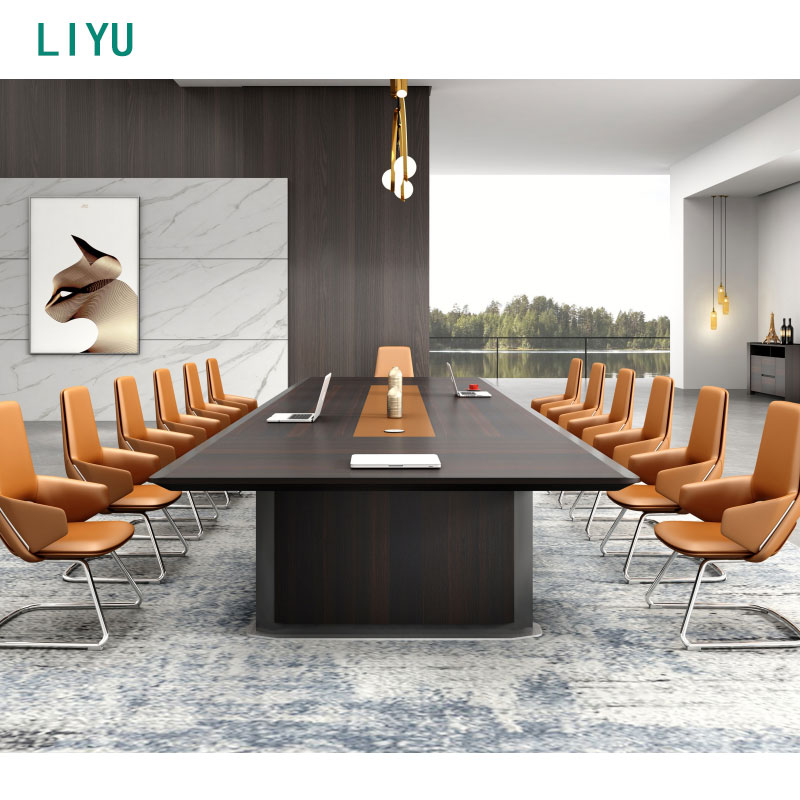
Complex table shapes require strict technical strategies for pattern alignment. Misaligned seams disrupt the visual flow and highlight manufacturing flaws. You must plan the pattern direction before cutting the substrate. When dealing with large conference tables that ship in multiple pieces, the factory must dry-fit the entire table, align the pattern across the seams, and install alignment dowels or draw bolts before shipping. If they skip this step, the installers will never get the pattern to line up perfectly on site.
Standardize the grain or pattern direction on single rectangular tables. Ensure the pattern runs parallel to the longest edge. This creates a continuous visual line that elongates the room. It simplifies the manufacturing process and reduces material waste. For custom digital prints, ensure the graphic file resolution is high enough to cover the entire surface without pixelation. A standard 150 DPI file will look blurry when stretched across an 8-foot table. Demand at least 300 DPI at full scale for any custom printed laminate.
Managing seams on L-shaped and U-shaped tables is challenging. You must handle 45-degree and 90-degree joins without disrupting the graphic. Specify precise CNC cutting for these joints. Require the manufacturer to dry-fit the pieces before edge banding to verify pattern continuity. If you are using a directional woodgrain, you must decide whether to use a mitered joint (where the grain changes direction to follow the shape) or a butt joint (where the grain runs straight through one section and stops at the other). Mitered joints look better but are significantly harder to execute perfectly.
Design non-directional patterns for modular setups. This allows flexible reconfigurability. Users can group tables without causing visual misalignment. Abstract speckles or tight geometric grids work best here. Directional woodgrains look chaotic when training tables are arranged in pods. If you must use a woodgrain on modular tables, specify a planked or heavily varied grain that hides the misalignment between adjacent tables. Avoid straight-cut, highly uniform grains, as any slight deviation in table height or placement will make the mismatch obvious.
Curved edges cause pattern warping and radial stretching during printing or pressing. Mitigate this by specifying patterns that naturally accommodate curves. Avoid rigid linear grids on circular tables. Work closely with the fabricator to ensure the graphic layer does not distort near the edge profile. When applying edge banding to a round table, the banding machine must apply consistent pressure to prevent the pattern on the edge tape from stretching or tearing. Specify a solid color edge band that complements the top pattern to avoid the complexity of matching a patterned edge tape to a curved surface.
Commercial specification sheets require quantitative metrics. Do not rely on visual samples alone. You must define the exact performance standards the table must meet. This ensures the final product survives the intended commercial environment. Vague specifications like "durable finish" lead to contractor substitutions that fail in the field. You must list the exact testing standards, acceptable wear cycles, and chemical resistance requirements in your documentation.
Specify acceptable Taber abrasion test results. Use NEMA/LD3 ratings for laminates. Differentiate between light-duty wear for private offices and heavy-duty wear for hot-desking zones. A premium tabletop finish must resist daily friction from laptops, keys, and coffee mugs. For high-traffic areas, demand a minimum of 400 Taber cycles for printed laminates. If the manufacturer cannot provide independent testing data for their custom printed surfaces, find another vendor. The print layer is often thinner than standard laminate decor layers, making it more susceptible to wearing through to the kraft paper core.
The patterned surface substrate must withstand structural movement. Height-adjustable and sit-stand frames cause surface vibration. Ensure balanced weight distribution to prevent warp. For heavy cast iron or steel T-Leg bases, specify pre-drilled inserts. This preserves the structural integrity of custom substrates and prevents screw pull-out. Never allow installers to use standard wood screws directly into MDF or particleboard cores on large tables. The constant movement and vibration will strip the holes. Mandate threaded metal inserts installed at the factory using CNC precision to ensure perfect alignment with the base plates.
Evaluate PVC, ABS, and solid wood edge bands. The edge is the most vulnerable part of the table. Specify zero-joint edge banding using laser, hot-air, or PUR adhesive application. This prevents moisture ingress and peeling on patterned laminates. Standard EVA glue lines accumulate dirt and eventually fail under commercial use. When a user spills coffee, it seeps into the EVA glue line, swells the particleboard core, and pops the laminate surface. PUR (Polyurethane Reactive) adhesive creates a waterproof, permanent chemical bond. Laser edge banding melts a polymer layer on the back of the tape, creating a seamless, invisible joint that protects the patterned surface perfectly.
| Edge Banding Adhesive/Method | Moisture Resistance | Heat Resistance | Visual Seam Quality |
|---|---|---|---|
| Standard EVA Hot Melt | Low (Prone to swelling) | Low (Reactivates at high heat) | Visible glue line, collects dirt |
| PUR (Polyurethane Reactive) | High (Waterproof bond) | High (Thermosetting) | Very tight, minimal glue line |
| Laser / Hot-Air (Zero-Joint) | Maximum (Seamless fusion) | Maximum | Invisible seam, flawless transition |
Ensure the chosen pattern method withstands hospital-grade disinfectants. Printed or textured surfaces must not ghost, fade, or delaminate when exposed to harsh chemicals. Request chemical resistance testing data from the manufacturer, especially for tables specified in dining or healthcare-adjacent areas. Many custom digital prints use inks that react poorly to bleach or ammonia-based cleaners. The protective melamine overlay must be thick enough to shield the ink. Test physical samples yourself by applying the facility's standard cleaning chemicals and leaving them for 24 hours to check for discoloration or surface softening.
Custom furniture procurement involves strict logistical realities. You must balance the initial capital expenditure against long-term performance. Understand the factors that influence overall value to make informed specification decisions. A cheap table that fails in two years is a massive drain on facility resources. You must evaluate the total lifespan of the product, including maintenance, repairability, and replacement frequency.
Custom digital print runs incur baseline tooling and setup costs. These fees cover file preparation, color calibration, and press setup. Specifying existing, cataloged architectural patterns eliminates these initial costs. Reserve fully custom prints for high-visibility areas where brand impact justifies the expense. If you are outfitting a massive open-plan office with hundreds of workstations, use a standard catalog pattern for the general desks and save the custom printed laminates for the main boardroom and reception areas. This concentrates the visual impact where it matters most while controlling the project budget.
Bespoke patterns extend production timelines. Factor in an additional 4 to 8 weeks for custom graphics. This impacts project handover schedules. Communicate these extended lead times to stakeholders early in the design phase. Ensure the physical strike-off approval process does not cause further delays. If the client rejects the first strike-off because the color is wrong, you lose another two weeks waiting for the second sample. Build this buffer into your critical path schedule. Never promise a fast-track delivery on a fully custom patterned table.
Balance a higher initial cost for a durable finish against lower replacement costs. A high-quality surface prevents early degradation. Look for longer manufacturer warranties. A 10-year commercial guarantee offers significantly better value than a standard 1-year warranty, reducing long-term maintenance budgets. Read the warranty fine print. Many manufacturers void the warranty if the table is cleaned with unapproved chemicals or if the edge banding fails due to moisture exposure. Specifying PUR or laser edge banding often secures a better warranty from the manufacturer because they know the edge will not fail.
Procurement and installation phases carry inherent risks. Identifying common points of failure allows you to build mitigation strategies into your specification documents. Protect the design intent by controlling the manufacturing variables. Do not leave technical details up to the contractor's discretion. If you do not specify the exact routing method for power modules, they will use a jigsaw on site, chipping the laminate and ruining the pattern.
Digital-to-physical color shifts ruin custom patterns. Mitigate this risk by mandating physical strike-offs. Review these test prints under the exact Kelvin temperature and color rendering index (CRI) of the intended office lighting. Never approve a custom office table surface design based solely on a PDF proof. A pattern that looks warm and inviting on a backlit monitor will look green and sickly under 4000K fluorescent office lights. Require the manufacturer to provide a 12x12 inch physical sample of the exact substrate, print layer, and topcoat. Take that sample to the job site and look at it in the actual room.
Power modules can destroy a carefully planned surface pattern. Map the CNC routing for power units during the design phase. Ensure the cutouts align with the graphic. Specify flush-mount, color-matched, or hidden under-desk modules to maintain an uninterrupted visual surface. If you have a large geometric pattern, do not drop a massive silver power box right in the middle of a critical design element. Work with the electrical engineer to shift the power modules to the seams or the edges of the pattern. Use anodized aluminum or powder-coated bezels that match the dominant color of the table surface.
Audit the manufacturer's portfolio before awarding the contract. Ensure they have specific experience with commercial-grade patterned surfaces. They must demonstrate the ability to deliver seamless pattern alignment across large-scale, multi-table orders. Request references for similar custom installations to verify their quality control processes. Ask the vendor how they handle pattern registration. If they print the laminate in one facility and press it onto the core in another, the chances of misalignment increase drastically. Prefer vertically integrated manufacturers who control the entire process from digital file prep to final edge banding.
The optimal patterned table specification relies on aligning the material's physical limitations with the room's expected traffic. You must account for configuration requirements and the overall interior design scheme. Prioritize manufacturers who offer transparent abrasion ratings and utilize advanced zero-joint edge-banding technology. They must provide physical strike-offs and demonstrate expertise in pattern continuity across complex configurations.
A: High-Pressure Laminate (HPL) and Sintered Stone are the most durable options for high-traffic commercial environments. HPL offers excellent impact and scratch resistance for digital prints. Sintered stone provides a non-porous, highly resilient surface that withstands heavy chemical cleaning and daily wear.
A: You must use template mapping during the design phase to align the cutouts with the graphic. Specify flush-mount, color-matched grommets to blend with the surface. Alternatively, use under-surface mounting solutions to keep the tabletop completely clear of visual interruptions.
A: Specify non-directional, geometric, or abstract patterns. These designs do not require precise alignment when users rearrange the tables. Avoid strict linear woodgrains or large continuous graphics, as they look disjointed when modular tables are separated or grouped differently.
A: Typical lead times range from 6 to 12 weeks. This depends on the complexity of the pattern, material sourcing, and the physical strike-off approval process. Custom digital printing and bespoke veneer inlays require additional setup and manufacturing time compared to standard catalog products.
A: Yes. Manufacturers achieve this through custom digital printing on high-wear HPL. For solid surfaces, they use CNC routing to create precise inlays. Back-painted glass printing is another effective method for applying sharp, vibrant brand motifs to a durable worksurface.
A: Detail the necessity of 2mm or 3mm ABS or PVC edge banding in your specification. Mandate zero-joint laser or PUR adhesive application. This creates a seamless, moisture-resistant barrier that protects the patterned substrate from peeling and impact damage in high-traffic areas.
A: Visual patterns on smooth surfaces are easy to clean. However, deep textured patterns trap dust and debris. If you specify a textured pattern, use non-porous materials like solid surface or HPL that can withstand rigorous scrubbing and hospital-grade disinfectants without degrading.


