
Views: 0 Author: Site Editor Publish Time: 2026-07-12 Origin: Site


The boardroom functions as the physical center of corporate authority and decision-making. Facility planners often prioritize aesthetic prestige over ergonomic reality in these spaces, resulting in seating that undermines high-stakes, multi-hour meetings. Occupants experience physical fatigue, which directly degrades focus and negotiation stamina. You must balance the visual weight of executive furniture with strict mechanical requirements. Diverse body types, spatial constraints of conference tables, and long-term durability expectations all demand careful consideration.
Evaluating a real leather office chair requires moving far beyond superficial design. You need to assess hide grading, dynamic adjustability, and structural integrity. Surface-level aesthetics mean little if the chair fails to support posture during an eight-hour mediation. This guide provides a technical framework for selecting seating that performs exactly as well as it presents, focusing on material authenticity, spatial geometry, and ergonomic scalability.
Selecting the right chair involves navigating a dual mandate. You must project institutional stability while actively preventing physical fatigue. Quarterly reviews and strategy sessions often stretch well beyond their scheduled times. A poorly designed chair creates discomfort, leading to distraction. You need seating that commands respect visually but operates as a highly functional ergonomic tool. The focus must remain on the meeting agenda, not aching lumbar regions.
Adopt a fit-first purchasing paradigm. Functional ergonomics and adjustability parameters must be verified prior to finalizing aesthetic selections. A beautiful chair holds no value if it forces the user into a slouched posture. You must evaluate the internal frame, the tilt mechanism, and the suspension system first. Once the mechanical foundation proves sound, you can then focus on the exterior finish. This approach guarantees that performance drives the selection process.
Establish duration-based comfort metrics for your facility. A one-hour briefing requires different support than a multi-day mediation. High-density foam becomes non-negotiable for extended sessions. Look for molded polyurethane foam with a density rating exceeding 50kg/m³. This material resists bottoming out over time. Seat pan cushion engineering must strike a precise balance. You want a plush initial feel, but the underlying structure must provide firm, unyielding support to the ischial tuberosities.
Universal fit requirements present a unique challenge in shared spaces. A dedicated boardroom chair does not belong to a single user. It must support the 5th percentile female and the 95th percentile male equally well. You cannot rely on complex, manual adjustments that require a manual to operate. The chair profile must naturally align with varied spinal curves. Seat depth should accommodate shorter legs without cutting off circulation, while the backrest must support taller torsos.
To ensure proper fit across a diverse user base, evaluate the following mechanical baselines:
Understanding the hierarchy of leather is critical for commercial procurement. Full-grain leather represents the highest tier of durability. It retains the natural surface of the hide, including all imperfections. This material develops a rich patina over time and offers maximum tensile strength. Top-grain leather provides a more uniform finish. Manufacturers sand away natural blemishes and apply a protective topcoat. Top-grain remains highly durable and is often the preferred choice for corporate environments requiring a consistent, flawless appearance.
You must actively avoid the "genuine leather" trap. In industry terminology, a genuine leather office chair often denotes lower-quality split leather. This is the fibrous inner layer left after the top grain is removed. It lacks structural integrity and requires heavy artificial coating. Bonded leather presents an even greater risk. It acts as a synthetic composite, combining shredded leather scraps with polyurethane binders. Bonded materials are highly prone to delamination and peeling under continuous commercial use.
Comparing polyurethane synthetics against real animal hide reveals stark differences. PU leather offers a uniform look and resists spills effectively. However, it severely lacks breathability. Users often experience heat buildup during long meetings. Real leather breathes naturally, adapting to body temperature. Tensile strength also heavily favors authentic hides. When evaluating office chair upholstery, real leather withstands structural pulling and stretching far better than synthetic alternatives.
Abrasion resistance dictates the visual lifespan of the seating. High-performance contract fabrics often boast 100,000+ double-rub ratings. Real leather naturally competes with these heavy-duty synthetic standards. It resists punctures, tearing, and friction wear at the edges. In high-turnover boardroom environments, chairs constantly rub against table aprons and adjacent seating. Authentic hides absorb this mechanical wear without catastrophic failure, whereas inferior materials quickly show exposed backing.
| Material Type | Durability | Breathability | Commercial Suitability |
|---|---|---|---|
| Full-Grain Leather | Maximum | High | Excellent (Develops Patina) |
| Top-Grain Leather | High | Moderate-High | Excellent (Uniform Finish) |
| Genuine Leather (Split) | Low-Moderate | Low | Poor (Prone to cracking) |
| Bonded/PU Leather | Low | Very Low | Poor (Prone to peeling) |
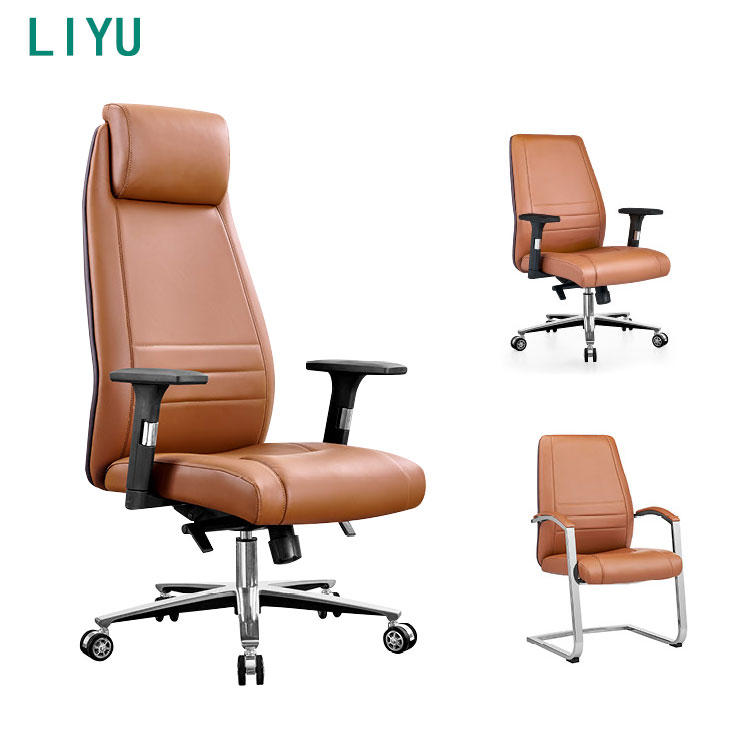
Shared seating environments demand intuitive mechanical design. Dynamic mechanisms outperform manual tension knobs in every boardroom scenario. Weight-activated tilt tension automatically calculates the required resistance based on the occupant's mass. A 110-pound user and a 250-pound user can sit in the same chair back-to-back and experience perfect recline support. This eliminates the awkward fumbling with under-seat dials during a presentation.
Critical adjustments must remain accessible but unobtrusive. Seat height adjustment is mandatory. Seat pan depth adjustment prevents circulation restriction behind the knees. Multi-axis armrests allow users to pull close to the table without obstruction. Synchronized tilt mechanisms keep the user's feet flat on the floor while reclining. This specific feature maintains continuous lumbar support, preventing the lower back from rounding when leaning away from the table.
You must calculate maximum seating capacity using strict spatial formulas. Never rely on visual estimation. A standard rule requires a minimum of 30 inches of linear table edge per person. For a 12-foot (144-inch) table, this allows roughly four chairs per side, plus one at each end. Attempting to squeeze additional chairs compromises personal space and restricts movement. Luxury executive seating generally features wider dimensions, making this 30-inch rule an absolute minimum.
Armrest clearance frequently causes implementation failures. You must measure the armrest height against the table apron clearance. If the armrests sit higher than the underside of the table, users cannot sit flush with the work surface. This forces them to perch on the front edge of the seat, destroying ergonomic posture. Continual collision also causes severe scuffing on the front edges of the leather arm pads.
Backrest height proportions require careful visual balancing. High-back executive designs project authority but can disrupt sightlines. If the chairs are too tall, they block views across the conference table and obscure presentation screens. Mid-back designs often provide a cleaner visual aesthetic while still delivering adequate thoracic support. Evaluate the ceiling height and room volume before committing to towering backrests.
Caster selection directly impacts floor preservation and user safety. Hardwood or polished concrete floors require soft polyurethane casters. These grip the hard surface and prevent the chair from rolling away too quickly. Carpeted boardrooms require hard nylon casters to overcome the friction of the pile. Using the wrong caster type damages flooring and creates a frustrating user experience.
Cylinder grading determines height retention and weight capacity. Specify Class 4 pneumatic gas cylinders for all commercial seating. Lower-tier cylinders leak gas over time, causing the chair to slowly sink during use. Class 4 components handle higher dynamic loads and ensure reliable operation across thousands of height adjustment cycles. The base itself should be constructed from polished aluminum or reinforced nylon, avoiding brittle plastics.
Procurement decisions must focus on longevity and replacement cycles. A premium top-grain leather chair will easily serve a boardroom for over a decade. Synthetic alternatives typically degrade, peel, or lose structural integrity within three years. Replacing failing chairs multiple times disrupts operations and damages the professional appearance of the room. Investing in commercial-grade materials upfront eliminates this continuous cycle of failure and replacement.
Market myths regarding cheap authentic hides persist. Quality leather requires extensive processing, tanning, and skilled upholstery. Commercial-grade, BIFMA-certified seating demands robust internal engineering. You cannot secure high-performance mechanisms and premium top-grain leather without a corresponding investment. Attempting to cut corners invariably results in compromised ergonomics or rapid material degradation.
Maintenance overhead presents a practical reality. Real leather requires periodic conditioning to maintain its suppleness and prevent cracking. Facility management must schedule this maintenance semi-annually. Lower-tier synthetics offer wipe-clean convenience but cannot be restored once the surface begins to peel. You trade minimal maintenance for a significantly shorter lifespan.
Aesthetic aging differs drastically between materials. Authentic hides develop a unique patina. They soften, conform slightly to usage patterns, and gain character. The material looks distinguished as it ages. Synthetic materials simply degrade. They crack, flake, and expose the underlying fabric mesh. A five-year-old leather chair looks professional; a five-year-old bonded chair looks neglected.
Climate and temperature control heavily influence seating comfort. Leather retains thermal energy. In poorly ventilated boardrooms, extended meetings lead to uncomfortable heat buildup. You can mitigate this risk by selecting perforated leather for the contact areas. Alternatively, hybrid designs featuring a leather seat pan paired with a breathable mesh backrest offer an excellent compromise between prestige and thermal regulation.
The "one size fits all" fallacy creates significant ergonomic risk. Aggressive, fixed lumbar curves alienate users who fall outside average height metrics. Fixed armrests prevent users from pulling close to the table. Mitigate this by selecting highly adjustable mid-back models. Ensure the lumbar support offers vertical adjustment. Prioritize multi-directional armrests that can retract or lower completely out of the way.
Acoustic impact rarely receives consideration until the first meeting. Leather rubbing against leather or against table edges creates friction noise. In quiet, high-stakes negotiations, squeaking chairs become highly disruptive. Prevent this by demanding quality construction and precise tailoring. Ensure all tilt mechanisms and pneumatic cylinders receive proper factory lubrication. Test sample units specifically for acoustic discretion before finalizing the order.
A premium leather chair serves as a sound investment only when material authenticity pairs with mechanical excellence. You must demand top-grain or full-grain hides. These materials must cover commercial-grade, weight-activated ergonomic mechanisms. Superficial aesthetics cannot compensate for structural weakness. Follow these actionable steps to finalize your selection:
A: A high-quality top-grain or full-grain leather chair can last 10 to 15 years in a corporate environment. Lower-quality "genuine" split leather or bonded leather typically begins to degrade, crack, or peel within 3 to 5 years under heavy commercial use.
A: Top-grain leather is authentic animal hide sanded for a uniform finish, offering high durability and breathability. Bonded leather is a synthetic composite made of shredded leather scraps mixed with polyurethane binders, which is highly prone to peeling and lacks durability.
A: Real leather is naturally porous and adapts to body temperature, making it reasonably breathable. However, in poorly ventilated rooms, it can retain heat. Perforated leather or hybrid mesh-back designs are recommended for extremely long sessions.
A: Allocate a minimum of 30 inches of linear table space per chair. Measure the total length of the table sides and divide by 30 to determine capacity. Ensure you account for the wider footprint typical of luxury executive seating.
A: A firmer cushion made of high-density molded foam (50kg/m³ or higher) is superior. While plush, soft cushions feel comfortable initially, they bottom out quickly, causing pressure points and lower back pain during extended meetings.
A: Yes. High-quality executive seating should carry BIFMA certification. This guarantees the chair meets strict commercial standards for structural integrity, stability, and ergonomic performance.
A: Wipe spills immediately with a dry cloth. Clean the surface regularly with a lightly damp microfiber cloth. Apply a high-quality commercial leather conditioner every 6 to 12 months to maintain suppleness and prevent the hide from drying and cracking.


