
Views: 0 Author: Site Editor Publish Time: 2026-10-14 Origin: Site


The short answer. Executive desks handle storage three ways. A desk with drawers puts everything below the top in pedestals and drawer banks: fastest to install, no wall needed. A desk with hutch stacks cabinets over the worksurface: maximum capacity per square meter, but it needs wall anchoring and changes the room's sight lines. A credenza is a separate low cabinet beside the desk: the most storage volume and the most flexible placement, at the cost of extra floor area. Match file formats first (Letter, A4 or Foolscap drawers), then lock level (key, code or fingerprint), then let the room size pick the shape.

The full storage wall: worksurface plus hutch above and closed cabinetry below. Each of the three storage shapes in this guide solves a different problem, and most buying mistakes come from choosing by look instead of by job.
Storage is where executive desk projects quietly succeed or fail. The desk itself gets all the attention, but the complaints that reach dealers six months later are about the other things: files that do not fit the drawers, cabinets that arrive without the locks anyone asked about, a hutch that leans because nobody specified wall anchoring. This guide is for buyers with real storage pain (document and equipment management, office designers planning capacity, and dealers configuring programs), and it compares the three storage shapes on structure, file compatibility, security and room fit.
The benchmarking vocabulary is straightforward. Storage components are covered by the same office-desk standards as the desk itself: ANSI/BIFMA in North America and EN 527 in Europe name the tests drawers, pedestals and hutch structures are expected to survive. You do not need to read the standards line by line; you need to ask which tests the components passed, and the five steps below turn that into a specification.
Same goal, three structures. Here is how each is put together, and what that structure buys or costs:
Aspect | Desk with drawers | Desk with hutch | Desk + credenza |
Structure | Pedestals and drawer banks under the top, fixed or mobile | Cabinet stack mounted on or behind the desk | Standalone low cabinet placed beside the desk |
Floor footprint | None beyond the desk | None beyond the desk (uses vertical space) | Adds roughly 0.8–1.2 m of wall |
Capacity | Moderate: 2–3 drawers per pedestal | Highest per m²: display + file + closed layers | Highest absolute: full-width shelving and files |
Sight lines | Clean | Tall; divides the room | Low; keeps the room open |
Install | Ships fitted or flat-pack, fast | Needs assembly at height and wall anchoring | Place and level, essentially done |
Best when | Room is tight, storage is personal | Room is small but storage is heavy | Room is large and storage is shared |
The structural differences drive everything else. A desk with drawers keeps its mass low, which is why it ships well and installs fast. A hutch trades floor space for height, so its structure questions (anchoring, load, total height) are questions about walls, not desks. A credenza is its own piece of furniture, which is why it can hold the most and move the most: re-plan the office next year and the credenza relocates while the hutch does not.

The drawers answer: personal storage lives under the top, within arm's reach. Nothing climbs the wall, which keeps small rooms flexible and installs fast.
Drawers are bought for files, and files come in three paper systems that do not interchange. The drawer you order must match the paper your market uses:
File system | Sheet size | Drawer requirements |
A4 | 210 × 297 mm | Fits most standard-depth drawers; front-to-back or lateral hanging rails |
US Letter | 216 × 279 mm | Similar depth to A4; common in North American programs |
Foolscap | 216 × 343 mm | Deeper drawer or adjustable rails; the classic mismatch when US furniture meets export markets |
The expensive mistake is ordering a desk whose drawers hold Letter for a market that runs A4 and Foolscap, or the reverse. Two questions settle it: Which paper system does the end client actually file? And do the drawers come with adjustable or swappable hanging rails? Factories that build for export (Liyu Furniture's export programs among them) are used to this question and can confirm per model; the honest answers are per-model answers, because a 600 mm-deep pedestal and a 450 mm-deep return drawer are different file machines. Where records mix formats, specify drawers with rails that re-position rather than fixed slots.
Two safety conversations belong in the specification, and neither is optional in commercial programs.
Locks come in three practical levels, and good factories offer them as a ladder: key locks as the baseline, code locks where several people share storage, and fingerprint or smart locks at the executive tier (Liyu's technology builds carry fingerprint locks as confirmed specification). What belongs on the order is the level per storage unit (drawers that hold contracts deserve a different answer than drawers that hold staplers), plus a written note of who re-keys or re-codes when staff change.
Structure safety is mostly about the hutch. A cabinet stack raised above the worksurface changes the furniture's center of gravity, so the specification should name the anti-tipping measures: connection hardware between hutch and desk, and wall anchoring on installation. The test names to reference are ANSI/BIFMA for drawer and pedestal structures in North American programs and EN 527 for European desk systems; components built to those references survive the daily shove-and-lean life of a real office. Drawer hardware earns its own line item: runner grade, load rating and damping (soft-close) decide whether the drawers still glide in year three, and asking for the runner specification in writing costs nothing at order time.

The credenza answer: full-width storage at credenza height, with room for a printer or refreshment tray on top. Shared storage lives here; personal storage stays in the drawers.
Room size picks the shape faster than any feature list. The bands below reuse the office planning arithmetic from the size guide (desk width plus chair zone plus walkways) and add the storage dimension:
Room / office size | Recommended storage shape | Rationale |
Up to 10 m² | Desk with drawers only (pedestal + drawer bank) | Floor is the constraint; drawers add zero footprint |
10–14 m² | Corner or L-shaped desk with drawers; hutch if wall space is free | Vertical storage solves capacity without new floor |
14 m² and up | Desk plus credenza, or full L-shaped run with return and hutch | Floor exists; separate storage adds capacity and shared access |
Shared executive zones | Credenza for common storage + personal drawers at each desk | Separates shared from personal, which prevents the re-stacking wars |
The decision logic in one sentence: drawers are personal, credenzas are shared, hutches are capacity; rooms under 10 m² rarely have the wall or the sight-line budget for a hutch, while rooms over 14 m² waste their walls without one. Mixed programs (a manager floor, for example) often run the cleanest line: drawers standard in every room, one credenza in the corner room that hosts meetings. That is the standard an executive desk with storage should be held to.
Storage failures are specification failures. Put these seven items on the order and make each one answerable in writing:
# | Specification item | What "locked" looks like |
1 | File format per drawer | A4, Letter or Foolscap named; hanging-rail adjustability confirmed |
2 | Storage shape per position | Drawers, hutch or credenza assigned to each desk position on the plan |
3 | Lock level per unit | Key, code or fingerprint named; re-key/re-code policy noted |
4 | Anti-tipping (hutch) | Hutch-to-desk connection hardware and wall anchoring named |
5 | Total height (hutch) | Finished height confirmed against room; window and sight lines checked |
6 | Runner grade | Slide specification, load rating and soft-close named per drawer |
7 | Test references | ANSI/BIFMA or EN 527 benchmark named; reports available on request |
Item 5 deserves its own reminder because it is the one nobody measures: a hutch that finishes at eye level looks authoritative in a 3 m ceiling and oppressive in a 2.6 m one. Factory planning bands for executive hutch configurations typically run 1650–1950 mm total height; confirm the number against your room before the order, not after the installation.
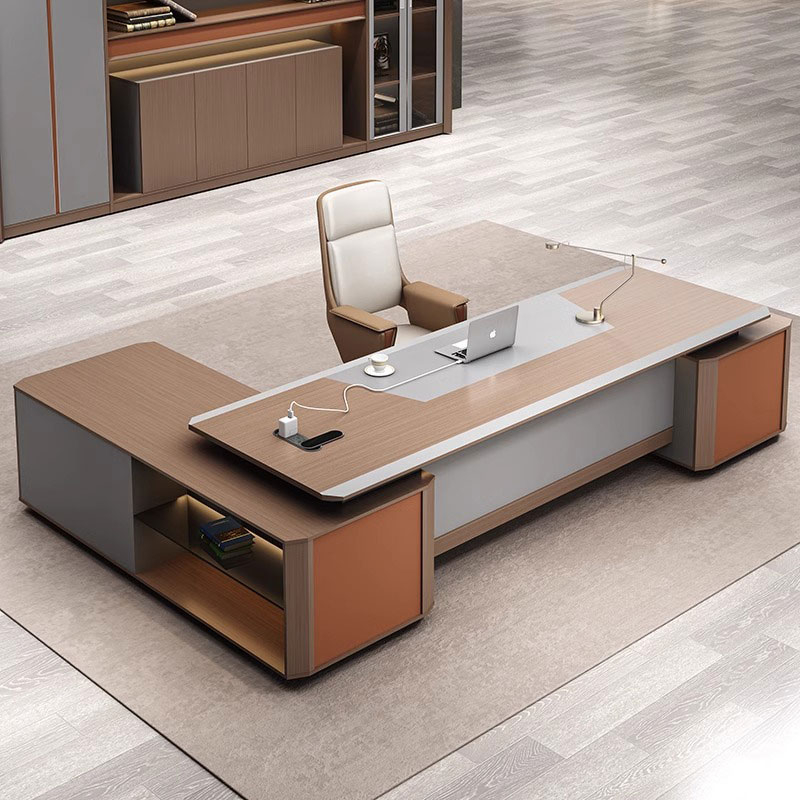
The pedestal detail view: three drawers of graded depth with soft-close runners. Personal, locked, and exactly as deep as the files require: that is the drawers answer working as specified.
Which is better, an executive desk with hutch or with drawers?
They solve different problems. Drawers keep storage personal and footprint-neutral, which suits tight rooms and shared floors. A hutch stacks capacity over the worksurface, which suits small-but-heavy storage needs and rooms with free wall space. Large rooms can have both: drawers at the desk, credenza on the wall.
Will A4 files fit in an executive desk with drawers built for Letter?
Not reliably, unless the drawers carry adjustable hanging rails. Foolscap files are deeper than both A4 and Letter and are the classic mismatch. Name the file format in the specification and confirm rail adjustability per model before ordering.
How do I stop an executive desk with hutch from tipping?
Specify the anti-tipping package: connection hardware between the hutch and the desk, and wall anchoring at installation. Raised storage changes the furniture's center of gravity, and the hutch structures built to ANSI/BIFMA or EN 527 references are tested with exactly this in mind. Anchoring is a one-line item that prevents the worst accident in the category.
What lock should executive desk storage have?
Match the lock to the contents: key locks for general drawers, code locks where several people share a unit, fingerprint or smart locks for executive storage with sensitive documents. The practical setup on good export programs is a ladder of all three, specified per storage unit on the order.
What storage fits an executive desk in a small home office?
Drawers only, ideally a mobile pedestal plus one drawer bank. Floor is the constraint in rooms under 10 m², and a compact hutch earns its place only when document storage is heavy. The three-layer home setup (pedestal, cabinet or hutch, open shelving) is covered in detail in the home office guide.
What storage options does Liyu Furniture build for executive desks?
The current line covers desk-and-drawer configurations (including two-drawer and three-drawer pedestals with soft-close runners), large return-and-credenza combinations on executive models such as the 2400 mm MG-WL02 build, and hutch configurations produced as OEM programs to drawings with wall-anchoring hardware specified. Locks ladder from key to code to fingerprint per unit; storage and file-format details are confirmed per model.
· Comparing drawer-equipped models? Browse the executive desk with drawers range: pedestal, drawer-bank and return configurations.
· Planning vertical storage? The executive desk with hutch page covers hutch configurations, anchoring and height planning.
· Mixed storage programs (credenza + drawers, custom heights) run through the customization process, or request a quote with your room plan attached.
Liyu Furniture is an office furniture manufacturer founded in 2007 in Lecong, Shunde (Foshan), Guangdong, in China's furniture manufacturing hub. Research, development, production, and sales run under one roof, and the catalog covers executive desks and tables, executive chairs, conference tables, file cabinets, office sofas, workstations and panels, and reception desks. OEM and ODM cooperation is welcome: production starts after drawings and samples are confirmed, and quotes are provided per model and specification.


