
Views: 600 Author: Site Editor Publish Time: 2026-11-06 Origin: Site


The short answer: pick the sofa by the job it must do, then the space it must fit, then the material that survives your cleaning routine, and compare quotes only on the same basis.
If you are working out how to choose an office sofa for the first time, the difficult part is rarely the color. It is turning a preference like "modern but not too casual" into criteria you can compare across models and across quotes. This guide gives you a working order: define the job the sofa must do, check the footprint, compare upholstery under the same conditions, inspect a sample, and put supplier quotes on one basis. It ends with a briefing you can copy and send to any supplier, including us.
One question deserves a straight answer before the sections start: the best sofa for office use is not a model name. It is the one whose seat count, dimensions and material match how your space is actually used, hour by hour. The rest of this page turns that sentence into checks you can run.
Three questions settle most of the specification before you open a single catalog: where the sofa will stand, how many people will sit at once, and how long they will stay. Reception visitors arrive in small groups, wait in short bursts and stand up often. Executive seating hosts one-to-one meetings that run long, so seat depth and back support carry more weight. Lounge seating absorbs a headcount that changes through the day, so flexibility matters more than formality.
Where will the sofa stand, and who sits down first?
Reception or waiting area. How many visitors arrive together, and how long do they wait? One or two at a time: a two-seat sofa covers the peak. Three or four: a three-seat sofa, or a set with matching armchairs, mirrors how groups actually arrive. Long waits, as in clinics and service centers: give priority to easy-clean upholstery and a seat that is firm enough to get out of easily.
Executive office. Does it host meetings, or just complete the room? Meetings: a three-seat sofa keeps visitors grouped on one side of the desk. Occasional seating: two seats, or a sofa plus one armchair, is enough. If it stands beside an executive desk, keep seat height and armrest height in scale with the desk line.
Lounge or breakout space. Does headcount change through the day? If yes, separate units can be re-arranged as the room is used. If the group is stable, one fixed sofa is simpler to clean around.
Concept decision flow for planning purposes, not a photograph of a real project.
Most office sofa types behind product names reduce to three forms, and the label alone will not always tell you which one you are looking at. A set is sold as one fixed group. In the product photo of LIYU model YQ-SC2208, a waiting-room sofa set, the group is a three-seat sofa, two armchairs and a coffee table; what any specific quote includes is a separate question, so ask the supplier to list the pieces and quantities in writing before comparing prices. A corner (L-shaped) sofa is one continuous unit that fills a corner efficiently, and its arrangement is fixed once it is on the floor. A true modular system consists of separate units you can re-arrange; if flexibility is the reason you are paying for one, ask exactly how the units connect, whether seat heights and seams align in every layout, and whether the corner is a single piece or two units joined.
This is also where the word "best" belongs. The best office sofa for your project is the one that matches the job description above, not the one with the most impressive photo. A set that looks right in a hotel lobby can still be the wrong answer at a clinic entrance.
Image source: LIYU product page. Model YQ-SC2208, a waiting-room set photographed with its three-seat sofa, two armchairs and coffee table.
Work size before material. A sofa that does not fit the room, or cannot reach the room, is eliminated no matter how good the material is. Upholstery can be compared after a shortlist exists, and on commercial models it is often specified per order. The sequence below is deliberately rigid, because it protects you from falling for a photo.
Measure the floor area where the sofa will stand, mark the walkway in front of it, and note the fixed features: door swings, columns, the reception desk and anything that has to open. People have to pass, and doors have to open.
Measure the delivery route: entrance and office door widths, elevator car depth, corridor widths, stair turns. A sofa that fits the room but not the elevator becomes a return shipment; packaged dimensions and any disassembly options belong to the same check.
Count seats needed at the same moment, at peak. A reception that receives forty visitors a day may still only seat four at once. Nominal places are not usable seats; arm width and how people share a sofa decide how many adults actually fit.
If the entrance serves visitors with limited mobility, reserve a clear position for a wheelchair user and check the accessibility requirements that apply to your building before fixing the layout.
Choose the configuration: a set, a corner unit, or separate units, using the distinctions from the section above.
Shortlist models last, and check each model's dimensions against your tape measurements. Wide-angle product shots compress scale, so compare a number with a number.
If the seating must serve laptops and phones, mark power positions on the plan now. Whether a given model offers integrated sockets, and which plug standard fits your market, is a model-level question to confirm with the supplier.
Both models used as examples in this guide, YQ-SC2208 and YQ-SC2206, list their size as "Customized" on the product pages, which is common in commercial sofa manufacturing. The practical meaning: the dimensions you compare in quotes come from the supplier's dimension sheet for your configuration. Ask for total width, total depth, seat width and seat depth in writing. For a three-seat executive sofa such as YQ-SC2206, total width is the number that decides whether it fits the wall behind the desk. Wide arms inflate overall width without adding seating, and a deep sofa eats into the walkway you measured in the list above.
Where practical, mark the sofa's footprint on the floor with tape before ordering, then walk the route: open the doors, pull out the adjacent chairs, and let the room rather than the photograph have the final word.
Material comparisons go wrong when each option is judged in a different context. Put every shortlisted model against the same four conditions: how it is cleaned, how it feels, how it behaves in a budget, and where it will actually sit.
Condition | Leather | Fabric | Confirm with the supplier |
|---|---|---|---|
Daily cleaning | Wipes down after spills; surface care is straightforward | Vacuuming is routine; stains can set without quick treatment | Which cleaning agents are safe for the exact material and grade |
Feel and impression | Formal, weighty first impression that suits executive rooms | Softer, more casual, wider color range | Whether the color is consistent across a multi-unit order |
Budget behavior | Material cost is higher, and the grade moves the number | A wider spread of entry prices across grades | Which grade the quote actually names |
Best fit | Executive offices and formal reception areas | Lounges and informal waiting areas | The traffic level and cleaning routine of your own space |
The table states general tendencies, not laboratory results; the material grade written into your quote decides how each row applies to you. That is also why this guide does not rank materials or brands. Grades and care requirements change between batches and models, so the useful comparison is the grade named in your quote, and the useful question is which cleaning routine the material survives. If a supplier quotes abrasion or colourfastness figures, compare them only against the same test method; a number from a different method is not an interchangeable buying score.
If leather is the direction, two details deserve questions before you sign. First, material zones: sofas upholstered in leather often use a matching material on panels that take less wear, such as outer backs and sides. The product page for YQ-SC2206 describes top-grain genuine leather; ask which panels of the exact model are leather, which are not, and in which grade. Second, care: ask in writing which cleaning agents the material tolerates. Waiting-room cleaning crews do not read upholstery labels.
Where traffic is heavy and cleaning is frequent, note that the YQ-SC2208 page also describes an easy-clean antibacterial vinyl option formulated for healthcare and high-traffic public spaces. Whether that option applies to your configuration, and how it should be maintained, is a per-order confirmation. And a wipeable surface is not automatically a disinfectant-proof surface, which is why cleaning agents stay on the question list.
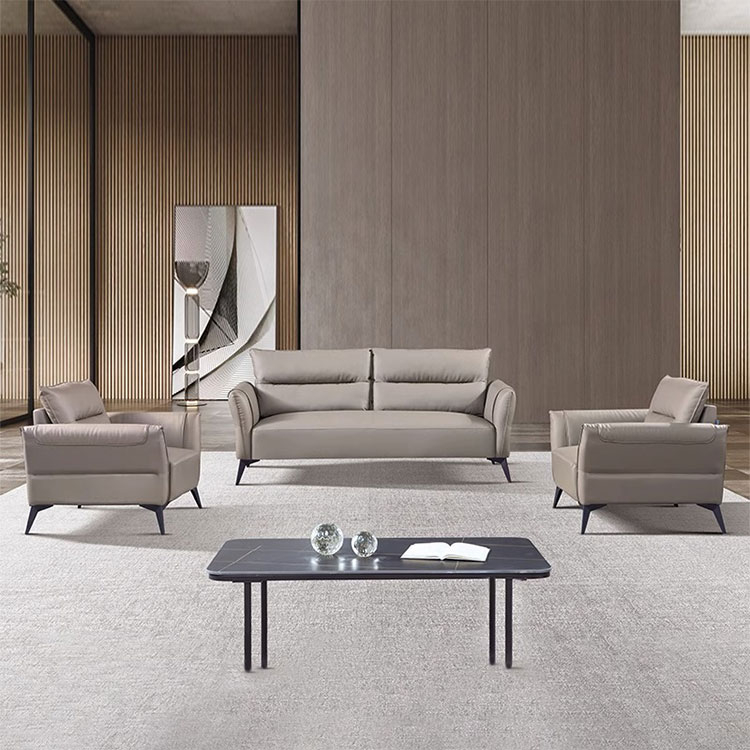
Image source: LIYU product page. Model YQ-SC2206, an executive three-seat sofa in leather, photographed with matching armchairs.
A sample session is a data-collection session. Comfort matters, but you are also checking whether the product the factory described is the product that arrives. Bring this list and take notes against it.
Seams and stitching: straight lines, no loose threads at armrests and seat edges, where stress shows first.
Frame feel: press the corners and the arms. A solid frame does not creak or rock on a level floor.
Material zones: identify which panels carry the primary material and which carry the matching material, then check the two zones for color match.
Sit test: the seat edge should not cut the back of your legs, and getting up should not require a push off the armrests. Match the firmness to the stay length you defined earlier.
Specification match: the sample and the quotation should agree on model number, dimensions, material and color code. For the models in this guide, the identifiers to check are YQ-SC2208 and YQ-SC2206, written in exactly that form.
Batch consistency: if you are ordering several units, ask whether the sample represents the production batch, and what tolerance applies between batches.
Paperwork: a dimension sheet, a material specification, and care instructions, each in writing.
One habit worth keeping: photograph the sample label and the stitching details before the sample leaves. Months later, when a re-order arrives and something looks slightly different, those photos are the reference both sides accept. Keep the approved material swatch with the order reference as well, and if a supplier shows a test report, read what it covers: a report written for one product does not automatically cover every item in the order.
Quotes differ for two reasons: the product differs, or the assumptions behind the price differ. Before comparing numbers, force every quote onto the same basis: same model number, same material and grade, same quantity in pieces and seats, same packaging basis, and the same trade term. Ask each supplier to state the trade term explicitly, for example FOB or CIF, because a price quoted on a different term is not a cheaper price.
The unit price is not the landed cost. Ask which of the following each quote includes: product price, packaging, inland transport in the origin country, international freight, insurance, import duties and taxes at destination, and local delivery with installation. Two quotes on different terms can differ by the entire freight line, and that difference has nothing to do with the sofa. Decide who pays each item in writing, and never treat an unquoted item as zero. If the specification changes later (a different colour, a shorter version, an extra module), ask for the revised configuration and terms before approving the order.
Send suppliers this structure and the quotes come back comparable:
Project: reception, executive office, or lounge
Model of interest (optional): for example YQ-SC2208, a waiting-room set, or YQ-SC2206, a leather executive three-seat sofa
Quantity: pieces or total seats
Space: room dimensions or a floor plan, plus door and elevator widths
Material preference: leather, fabric or vinyl, with a color direction
Delivery: country and city, and the target delivery window
To be stated in the quote: exact pieces included per set, whether tables are included, packaging, trade term, price validity, and how discrepancies, spare parts and after-sales support are handled
Your contact: name, company and email
A layout request earns its keep when several furniture groups share one room, doors or columns make the plan awkward, or you are weighing straight, facing and corner arrangements. A dimensioned sketch with the entrance and fixed furniture marked says more than a room-area figure.
Email the brief to ada@liyu-furniture.com or send it through our contact page. If your idea of the space is still rough, send the scenario and the city first; a layout suggestion can come before a formal quote.
Should I choose the sofa size or the material first?
Size first. A sofa that cannot fit the room, or cannot reach it, is out regardless of material, while upholstery can usually be compared and specified after a fitting shortlist exists. Screen any restrictive cleaning requirement early, then finalise the material among the models that fit.
How many office sofa seats do I need?
Count the people likely to need seats at the same moment, not the daily visitor total. Then check usable seat widths and how your visitors share seating, because nominal places and usable places are rarely the same number.
Is a sofa set the same as a modular sofa?
No. A set is a fixed group sold together, such as a sofa with matching armchairs and sometimes a table. A true modular system has separate units with defined connections, so ask for unit codes, connection details and overall dimensions before relying on future rearrangement.
What belongs in the total project cost of an office sofa?
Beyond the furniture price, an imported order may include export packing, freight, insurance, destination handling, duties or taxes, onward delivery and installation, depending on the agreed trade term. Ask which items each quote covers, and do not treat an unquoted item as zero.
When should I ask for a seating layout review?
Ask early when several furniture groups share a small room, the entrance route is awkward, or you are comparing straight, facing and corner arrangements. Send a dimensioned sketch showing the entrance and fixed furniture; a room-area figure alone does not explain the constraints.
Can I get a quotation before choosing a model?
You can start the conversation with your use, space, expected group size, quantities and delivery location. A supplier can suggest suitable directions, while a final comparable quote needs a defined model, configuration and material specification.
If the order above settled your scenario, capacity and material direction, a focused product list beats browsing the full catalog. Three paths cover most first projects.
Reception and waiting room sofas. Sets with armchairs and tables, plus easy-clean material options for high-traffic entrances.
Executive office sofas. Sized and styled to sit beside an executive desk, including leather three-seat models such as YQ-SC2206.
Leather office sofas. The material-zone and care questions from the upholstery section apply to each model.
Whichever path you take, the briefing from the section above is what turns browsing into a comparable quote.
Ready to compare what is available today?
Browse the current office sofa range, then send the briefing above with your scenario, city and timeline.


