
Views: 1200 Author: Site Editor Publish Time: 2026-11-06 Origin: Site


The short answer: before you commit to a bulk order, get five things fixed in writing. The product scope. An approved sample basis. The OEM/ODM split of duties. Documents that match your market. The commercial terms for packaging, timing and after-sales. Everything else in supplier talks is detail around those five.
This office sofa supplier checklist is written for importers, dealers and contractors buying office sofas at wholesale quantities, who already know roughly which sofa they want, and now have to make sure a bulk order delivers what they approved. Choosing a model is its own task. The harder failures happen later, between approval and arrival: a container lands with a color that drifted from the sample, a "set" turns out not to include the armchairs in the photo, a report exists but was written for a different model than the one you bought.
None of these require bad faith to happen. They happen when assumptions were never written down. The six sections below each end in something you can put into an email, a table or a signed line, and the last section gives you a complete RFQ template you can copy.
A supplier can only quote what you define. Write the scope down before comparing anyone, because every blank field invites two suppliers to assume different things and return numbers you cannot compare.
Scope item | Write this down | Why it moves the quote |
|---|---|---|
Space and scenario | Reception, executive office, lounge, or a mix, plus the building type | Form, material and cleaning routine all follow the scenario |
Sofa form | Fixed set, corner unit, or separate modular units | A set prices per group; modular pricing runs per unit |
Seats and units | Pieces, seats per piece, total seats across the order | Freight, MOQ and per-seat cost all key off this |
Upholstery direction | Leather, fabric or vinyl, with a color direction and grade expectation | The single biggest price and lead-time variable |
Market and use | Delivery country and city, and the end-use building type | Documentation and material suitability follow it |
Quantity and phasing | Units now, units later, and any re-order intent | Price breaks, MOQ and batch color consistency depend on it |
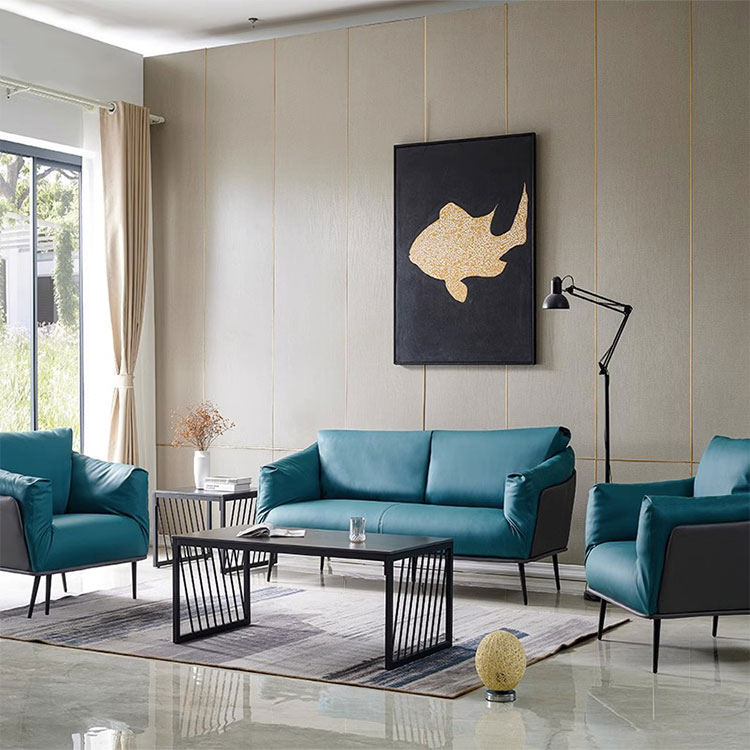
One scope line deserves special care: what a "set" contains. Product photos help, but a photo is not a bill of materials. The product photo of LIYU model YQ-SC2208, for example, shows a waiting-room arrangement of a three-seat sofa, two armchairs and a coffee table. Whether any given quote includes all of those pieces, in those quantities, is a question to settle in writing before prices are compared at all.

LIYU product page. Model YQ-SC2208, a waiting-room set photographed with its three-seat sofa, two armchairs and coffee table.
If the scope is still open when you start, it pays to see which forms actually exist before fixing the numbers. The full office sofa range groups current models by scenario, which makes the scope table above faster to fill in.
A sample is not a formality. For a bulk order, its job is to become the reference both sides point at for months: at pre-shipment inspection, at the warehouse door, and at any claim. Treat the sampling round as a data-collection session, and request at minimum:
A physical sample of the exact model in your configuration. When freight makes that impractical, a material kit instead: the upholstery swatch, an arm or leg part, and the packaging seen in person.
Swatches with grade names and color codes, not "leather" or "fabric" as bare words.
A dimension sheet for your configuration: total width and depth, seat height and seat depth, each tied to a named configuration code.
The material zone map: which panels carry the primary material, which carry the matching material, and whether the two are the same grade.
Care instructions written for the exact material and grade in your quote.
Then convert the sample into an approval baseline, and keep it boring and specific: model and configuration code, material grade and color codes, leg and hardware finish, stitching form, packaging type. Keep the approved swatch with the order reference, and photograph the sample's labels and stitching before it leaves your desk. Months later, when a re-order arrives and something looks slightly different, those photos are the reference both sides accept.
Two boundary rules protect this baseline. First, an approved sample covers that unit under that specification; it does not automatically extend to a new colorway or to future batches unless a batch tolerance has been agreed in writing. Second, any later change (a different color, a shorter version, an extra module) needs a revised configuration and revised terms in writing before you approve it. Verbal agreements are where re-orders drift.
If leather leads your shortlist, surface mapping is the question that matters most, because leather upholstery often uses a matching material on the panels that take less wear, such as outer backs and sides. The leather office sofas page compares models by upholstery surface, which pairs naturally with the swatch request above: approve the swatch against the zone it covers, not the sofa in general.
LIYU product page. Model YQ-SC2078, a leather set; the swatch you approve should identify the exact grade and color shown here.
In office sofa programs, OEM and ODM describe who originates the design. In an OEM arrangement, your side supplies the design, the material specification and the branding, and the factory builds to that definition. In an ODM arrangement, the factory proposes from its existing platforms and forms, and you adapt: size, color, material, branding details. Most real orders mix both across a single program, a fully custom reception run alongside adapted platform units, so state which mode applies item by item instead of labeling the whole order one or the other.
The published customization process on our customization page follows the same logic in three steps: requirements first (usage, size, style, function, budget), then a deepened scheme with itemized materials, dimensions and prices, then production under quality control. Whatever supplier you work with, the checklist point is the same: the itemized middle step is the one that matters, because that is where responsibilities become visible.
Area | Buyer provides | Supplier provides | Approved in writing by both |
|---|---|---|---|
Design source | Drawings, reference samples, or a design brief | Production drawings converted from either | Final drawings before the first sample |
Dimensions | Room dimensions and access constraints | Dimension sheet per named configuration | The signed dimension sheet |
Materials and color | Direction: material type, color, grade expectation | Grade availability, swatches, color codes | Swatch sign-off against material zones |
Branding | Logo files, placement, application method | Application on the specified panels | A pre-production photo of the applied mark |
Sample approval | Approval criteria and the people who decide | The sample built to the final drawings | The sample record kept with the order |
Documents | Destination-market requirements | Spec sheets and material documentation for the model | A coverage check against your market |
The table is not bureaucracy for its own sake. It prevents the two classic OEM failures: the factory assumes a detail nobody approved, and the buyer assumes a capability nobody confirmed. Asking early "which parts of my OEM office sofa program are built to my specification, and which are adapted platform models" costs one email and saves a season.
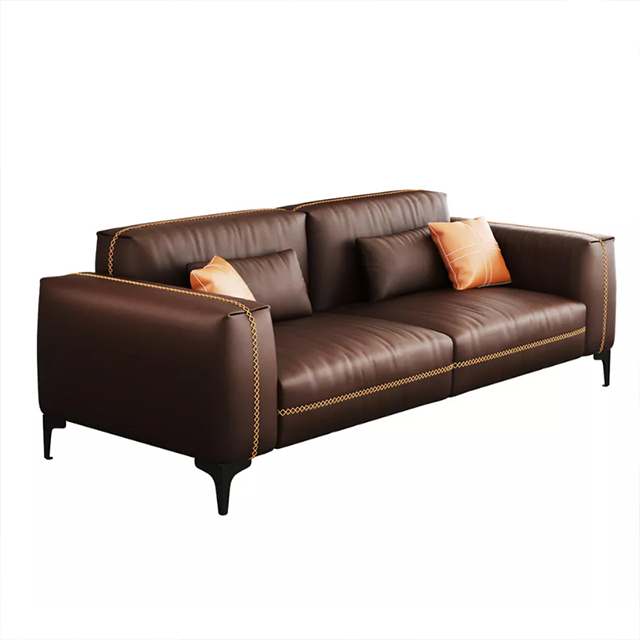
Image source: LIYU product page. A three-seat executive sofa with contrast decorative stitching; stitching, piping and leg finishes are among the details that can be specified per order.
Documents are where bulk orders get quietly downgraded. A report exists, so the file looks complete, but it was written for a different model, a different material grade, or a different test method than your market expects. The habit that prevents this: match every document against model, material, date and market, and treat a document that fails one of the four as not covering your order.
Document | What it must show | What to ask |
|---|---|---|
Product specification sheet | Model, configuration, dimensions, materials per zone | Does this sheet match the approved sample code exactly? |
Material documentation | Grade, color code, and the test method behind any quoted figure | Which method produced these numbers, and on which material batch? |
Market-specific certificates | Scheme name, covered model, validity period | Does it name this model, and is it recognized for my destination market? |
Inspection records | What was checked, against which baseline, and when | Can I see the pre-shipment check basis before balance payment? |
Care instructions | Cleaning agents and methods for the exact material | Which agents are safe for the grade written in my quote? |
Three reading rules keep the table honest. A test report written for one product does not automatically cover every item in the order. Numbers measured under different test methods are not interchangeable scores. And a certificate belonging to another buyer, or to a different product line, is not evidence of your supplier's capability for yours. If a figure matters to your project, tie it to the model and material you are actually buying, in writing.
Product quality and commercial terms are separate agreements, and the second decides whether the first survives the journey. These are the questions to close before the deposit, grouped so you can paste them into an email:
Order basis
Is the MOQ set per model, per material, or per color?
Are mixed colors allowed within one order, and does a mixed-color order change the price or the timeline?
What is the price validity, and at what quantity do price breaks apply?
Packaging
Is the sofa shipped knocked down or fully assembled, and which parts disassemble?
What are the carton dimensions and piece counts, and can the carton marking follow your requirements?
Does the packaging protect the approved finish for your freight mode, sea or land?
Timing
Which milestones get dates: deposit, sample approval, production start, pre-shipment inspection, ex-factory, vessel departure?
How are delays notified, and how early?
What confirmation follows each milestone?
After-sales
What does the warranty cover, for how long, and on which components?
Which spare parts are kept available, and how do they ship with a re-order?
How is a claim filed: photos, order reference, and against which baseline (the approved sample)?
On costs, one rule carries most of the weight: an item that is not quoted is not zero. The lines between ex-factory and your warehouse (inland transport, export packing, freight, insurance, duties, onward delivery) belong to the trade-term discussion. Ask each supplier to state the term explicitly, for example FOB or CIF, and decide who pays each line in writing.
The RFQ decides the quality of the quotes you get back. Send the same brief to every supplier on your list, gaps included; a brief with a few open fields still produces comparable answers, and the scenario plus city alone are enough to start a conversation.
Subject: Office sofa RFQ: [project name], [quantity] seats to [country]
Hello [supplier name],
We are sourcing office sofas for [reception / executive office / lounge] in [city, country].
Scope
Sofa form: [fixed set / corner unit / modular units]
Units and seats: [for example 8 sets of 1+2+3, total 24 seats]
Upholstery direction: [leather / fabric / vinyl], color direction: [reference]
Delivery country and city: [to fill in], target window: [month]
Please quote on the same basis and state:
Exact pieces included per set or per unit
Dimensions per configuration: total width and depth, seat height and depth
Material grade, color code, and material zones (primary vs matching panels)
Packaging form, carton details, and piece counts
MOQ basis: per model, per material, per color, and mixed-color rules
Trade term (for example FOB or CIF) and what the price includes
Milestones: sample time, production time, inspection point
Warranty, spare parts and claim handling
Documents available for the quoted models: specification sheet, material documentation, care instructions
Attached (optional): a floor plan with door and elevator widths, so packaging and site access can be checked before quoting.
Contact: [name], [company], [email]
Send it to ada@liyu-furniture.com or through our contact page. If your scope is still rough, send the scenario and the city first; a short first exchange beats a stalled formal one.
While quotes come back, the commercial pages shorten the comparison on this side: reception office sofas for entrance and waiting zones, and executive office sofas for leadership rooms, each with the set forms and material directions referenced above.

LIYU product page. Model YQ-SC2206, an executive three-seat sofa in leather, photographed with matching armchairs; naming the model in the RFQ makes every answer traceable.
Is MOQ calculated per model or per color?
Neither answer is universal; suppliers set it differently by model line and material. Ask before sampling, and get three things in writing: the MOQ per model, whether the count changes by material or color, and whether mixed colors are allowed within one order.
What is the difference between OEM and ODM for office sofas?
OEM means your side supplies the design, the specification and the branding, and the factory builds to that definition. ODM means the factory proposes from its existing platforms and you adapt size, color, material and branding. Most programs mix both, so state which mode applies item by item.
Which documents should I collect before production starts?
At minimum: the dimension sheet for your named configuration, the material specification with grades and color codes, the approved sample record, and care instructions for the exact material. Add test reports or certificates tied to your market where they matter, each checked against model, date and coverage.
How do I keep the bulk order consistent with the approved sample?
Convert the sample into a written baseline: model code, grades, color codes, finishes, packaging. Keep the approved swatch with the order reference, agree the batch tolerance in writing, photograph labels and stitching, and process any change through a revised written configuration.
How are warranty, spare parts and claims handled on imported sofa orders?
These are agreed terms, not defaults. Close the coverage, the duration, the spare-part availability and the claim process (photos, order reference, baseline) before the deposit, so a claim is checked against the approved sample rather than against opinions.
How long does it take from sampling to shipment?
There is no honest single number; it moves with the configuration, the materials and the factory's order queue. Fix milestone dates in writing (deposit, sample approval, production, inspection, ex-factory) and treat unconfirmed dates as targets, not promises.
Ready to put the checklist to work?
Copy the RFQ template above with your scenario, city and timeline, or browse the office sofa range first if the scope is still open.


