
Views: 0 Author: Site Editor Publish Time: 2026-09-19 Origin: Site


Open-plan office layouts clash directly with strict clean desk policies and data privacy requirements. Facility managers and procurement teams face a specific operational challenge: determining exactly when a workstation requires integrated security. Providing inadequate storage exposes the organization to data breaches, stolen hardware, and compromised employee trust. Conversely, over-specifying locking hardware for every single employee creates unnecessary upfront expenses and an ongoing administrative nightmare of lost keys.
This guide provides a practical framework for evaluating when an office desk lock is a strict operational requirement versus a discretionary perk. You will learn how to align furniture investments with regulatory compliance, assess role-based storage needs, and navigate the hidden logistical costs of mechanical versus smart locking systems. By applying these criteria, procurement teams can make evidence-based furniture investments that balance aesthetics, security, and budget.
Physical security acts as the absolute foundation for digital security. Organizations spend heavily on firewalls, encrypted networks, and multi-factor authentication, yet frequently ignore the physical vulnerabilities sitting right on a workstation. Compliance frameworks like HIPAA, GDPR, and ISO 27001 mandate strict, auditable controls over physical access to sensitive information. An unattended security token, a printed client roster, or an unencrypted external hard drive left on a desk represents a severe liability during a compliance audit. Auditors look for physical gaps just as closely as network vulnerabilities.
Lockable storage enables the successful enforcement of a corporate Clean Desk Policy. When employees have a secure, immediate place to store sensitive materials at the end of their shift, compliance becomes a seamless part of their daily routine rather than a chore. This prevents casual snooping by overnight cleaning staff, daytime visitors, or unauthorized personnel walking over from other departments. Without integrated locking mechanisms, enforcing a clean desk mandate becomes practically impossible. Employees end up forced to carry sensitive documents home in their bags or leave them exposed under keyboards, defeating the entire purpose of the policy.
Beyond paper documents, modern workstations house high-value physical assets. Unsecured company laptops, specialized testing equipment, proprietary product prototypes, and mobile testing devices present a massive financial risk. Theft or loss of these items incurs immediate replacement costs and halts employee productivity for days while IT provisions new hardware.
Establishing a baseline return on investment for secure storage requires calculating your specific hardware replacement costs. If a department routinely uses specialized tablets, calibrated engineering tools, or proprietary hardware, the cost of replacing just one stolen device often exceeds the price difference between a standard open desk and a secure workstation. Providing a locking drawer directly at the point of use ensures these assets remain protected during lunch breaks, cross-departmental meetings, and overnight. You eliminate the friction of asking employees to haul heavy equipment to a central secure room multiple times a day.
The shift toward hot-desking and hybrid work environments strips away the traditional sense of personal territory. Employees no longer have a permanent space to call their own, which can lead to a feeling of detachment. Providing secure personal storage significantly impacts employee satisfaction. A lockable drawer gives staff a secure anchor for personal belongings like wallets, keys, medication, and gym bags.
Providing this secure space also acts as direct liability mitigation for the employer. When personal items are stolen from an open office, it creates immediate friction, triggers HR investigations, and damages trust across the team. Dedicated storage prevents these incidents entirely. Furthermore, it helps employees maintain an organized workspace. By reducing surface clutter, employees experience fewer visual distractions, leading to improved focus and a much more professional office appearance for visiting clients.
C-suite executives and Human Resources personnel handle the most sensitive information in any organization. Performance reviews, strategic expansion plans, unredacted financial forecasts, and confidential personnel files require immediate, secure access. These roles cannot rely on remote filing rooms down the hall; they need security directly at their fingertips to maintain workflow efficiency.
An executive desk with storage solves this requirement by balancing high-capacity security with professional aesthetics. These desks typically feature heavy-duty locking pedestals integrated seamlessly into the wood veneer or metal chassis. This allows leaders to secure confidential documents instantly when an unexpected visitor enters the office. They can sweep sensitive papers into a drawer and lock it in one motion, maintaining privacy without disrupting the flow of conversation or compromising the executive appearance of the suite.
Departments managing contracts, payroll runs, and IT infrastructure access operate under strict storage mandates. Legal teams handle physical evidence, wet-signed contracts, and litigation holds. Finance teams manage physical checks, banking tokens, and tax documents. IT staff often secure master access badges, server room keys, and unconfigured hard drives containing proprietary software images.
These roles require heavy-duty locking mechanisms. Standard cam locks are entirely insufficient for this level of risk. Procurement teams must evaluate multi-point locking systems and, in some cases, fire-rated storage solutions. The hardware must withstand frequent daily use while providing a certified level of resistance against forced entry. Workstations for these departments should prioritize security grading over minimalist design, utilizing heavy-gauge steel pedestals and reinforced strike plates.
Not every employee requires heavy-duty security. For general staff, marketing teams, or creative departments, speed and accessibility often outweigh the need for strict confidentiality. Over-specifying locks for these roles wastes budget and creates unnecessary key management tasks for the facilities team.
Procurement teams must assess standard employee needs in fast-paced environments. Often, an office desk with bookshelf provides superior utility. It optimizes the workspace for quick access to reference materials, paper samples, and brand guidelines. By utilizing open shelving for low-risk tasks, organizations can allocate their security budget more effectively to the departments that genuinely require closed, lockable pedestals. This targeted approach keeps the office feeling open and collaborative while maintaining security where it actually matters.
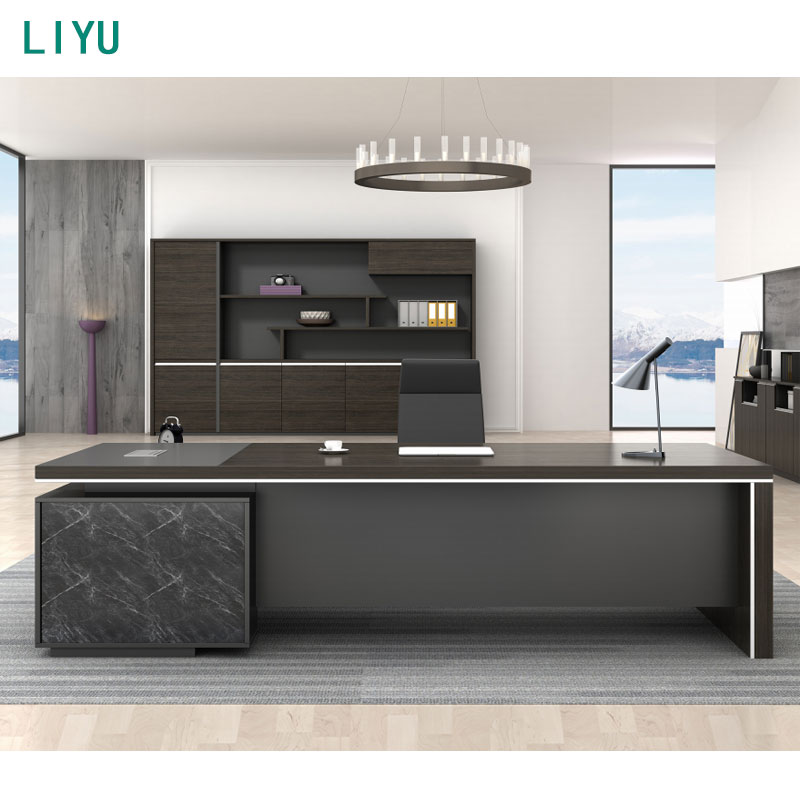
When selecting secure storage, facility managers must choose between built-in solutions and separate units. Integrated desk pedestals offer significant space-saving benefits. They utilize the dead space beneath the work surface, keeping the overall footprint of the workstation compact. This is highly efficient for high-density office layouts where every square foot of real estate matters.
Conversely, a standalone wooden file cabinet provides high-capacity, modular flexibility. If an employee moves to a different department, the cabinet can move with them without requiring a complete desk teardown. Standalone units generally offer thicker construction and higher security grading for confidentiality protection. However, they require dedicated floor space. The decision relies on balancing the available square footage against the volume of sensitive materials the employee needs to store on a daily basis.
Mechanical locks represent the traditional standard. They offer a low upfront cost and require zero technical infrastructure. However, they are highly vulnerable. Master keys get lost, and standard cam locks are easily picked or forced open with basic hand tools. The administrative burden of managing physical keys often negates the initial cost savings.
Smart or RFID locks eliminate physical keys entirely. They integrate directly with existing employee ID badges. This ensures minimal downtime in fast-paced work environments; if an employee loses a badge, the system administrator simply deactivates it and issues a new one. Smart locks also provide audit trail capabilities, logging exactly when a drawer was accessed.
| Lock Type | Upfront Cost | Security Level | Maintenance Requirement | Best Use Case |
|---|---|---|---|---|
| Standard Cam Lock | Low | Basic Deterrent | High (Lost key replacement) | Low-risk general staff storage |
| Interchangeable Core (IC) | Medium | Moderate | Low (Instant rekeying) | High-turnover departments |
| RFID / Smart Lock | High | High (Audit trails) | Medium (Battery replacement) | Strict compliance roles (HR, IT) |
The rise of agile and hybrid workplaces has shifted storage strategies. When employees do not have assigned seating, point-of-use desk locks become highly impractical. Centralized smart lockers provide a highly viable alternative. Employees can claim a locker for the day to store personal belongings and laptops, freeing up the shared desks for purely collaborative work.
However, for employees with assigned seating who process physical documents throughout the day, centralized lockers create severe inefficiencies. Walking across the floor to retrieve a file disrupts focus and wastes time. For permanent, compliance-heavy roles, the immediate convenience of point-of-use desk storage remains the superior operational choice.
Purchasing a desk with a standard mechanical lock is only the first expense. The operational reality of key management introduces significant hidden costs. Employees lose keys constantly. Employee turnover results in unreturned keys. When a key goes missing, facility managers must spend time drilling out the old cylinder and installing a new one, resulting in labor costs, metal shavings on the floor, and workstation downtime.
Organizations must implement strict mitigation strategies. Establishing a rigorous master key protocol is mandatory. A more effective hardware solution is utilizing interchangeable core (IC) locks. IC locks allow a facility manager to use a specific control key to remove the entire lock cylinder in seconds and swap it with a new one. This eliminates the need for drilling and drastically reduces the administrative overhead of lost keys.
Storage hardware must endure years of daily physical impact. Cheap cam locks suffer from high failure rates. They utilize a thin piece of metal that rotates behind a frame lip, which bends or snaps under pressure. Commercial-grade multi-point locking systems distribute the securing force across the entire height of the drawer, offering vastly superior durability.
Smooth mechanical operation is critical. Avoid low-cost knock-offs where the shut-and-unbolt motion is prone to jamming. A jamming lock causes immediate employee frustration and productivity loss. Furthermore, the weight of stored materials impacts the furniture over its 5-to-10-year lifecycle. Heavy paper files cause poorly constructed drawers to sag. When a drawer sags, the locking mechanism misaligns, rendering the lock useless. Investing in heavy-duty drawer glides is just as important as the lock itself.
Maintaining a cohesive office design while mixing secure and non-secure furniture presents a distinct challenge. An office floor looks disjointed if the finance team sits at heavy steel security desks while the marketing team uses minimalist wood tables. The goal is to achieve functional security without compromising the architectural vision.
Procurement teams should source furniture lines that offer consistent finishes across different security tiers. Modern manufacturing allows heavy-duty locking mechanisms to be concealed within standard wood veneers or powder-coated steel frames. Specify hardware that mounts flush with the drawer face, ensuring the structural integrity of the lock does not ruin the visual lines of the workstation.
An office desk lock is not a universal requirement for every employee. It is a highly targeted tool designed to ensure regulatory compliance, protect high-value physical assets, improve organizational efficiency, and provide employees with peace of mind. Over-deploying locks wastes capital and creates logistical headaches, while under-deploying them exposes the business to severe security risks. Apply a strict decision matrix when shortlisting furniture. Prioritize integrated, heavy-duty locks for assigned roles handling compliance data. Utilize standalone cabinets for departments requiring high-volume secure storage. Reserve open shelving and non-locking desks for low-risk, highly collaborative tasks. This balanced approach optimizes your procurement budget.
Take the following steps to upgrade your office storage strategy:
A: Yes, retrofitting is possible. You can install standard cam locks or battery-operated smart locks onto existing wooden or metal drawers. This requires drilling precise holes through the drawer face and frame. However, modifying the furniture yourself will almost certainly void the manufacturer's warranty and may compromise the structural integrity of the drawer.
A: Standard desk locks primarily act as a deterrent. They are highly effective at preventing casual snooping, keeping honest people honest, and enforcing Clean Desk Policies. However, basic cam locks do not provide robust protection against a determined individual with tools who intends to force entry.
A: An IC lock features a removable cylinder. Instead of drilling out the entire lock when a key is lost, a facility manager uses a special control key to extract the core. A new core with a different key configuration is then inserted in seconds, drastically reducing maintenance time and costs.
A: Effective management requires strict protocols. Facilities must maintain a secure, updated key log spreadsheet. Implementing a master key system allows managers to access any desk in an emergency. Utilizing core-removable (IC) locks is the best physical strategy, allowing for immediate rekeying without replacing the entire lock assembly.
A: Metal cabinets generally offer superior structural integrity and can be manufactured with specific fire-resistance ratings. Wooden cabinets provide a warmer aesthetic appeal and use standard locking mechanisms that deter casual access, but they are more susceptible to forced physical entry and offer minimal fire protection.
A: Generally, no. Hybrid workers who utilize hot-desking do not benefit from point-of-use desk locks. Instead, organizations should deploy centralized smart lockers where hybrid employees can secure personal belongings and laptops for the day, reserving lockable desks strictly for staff with permanent, assigned seating.


