
Views: 0 Author: Site Editor Publish Time: 2026-09-23 Origin: Site


Modern interior architecture has shifted away from monolithic, single-material furniture. We now rely on high-contrast, dual-finish workstations to define spatial zones, integrate into multi-use spaces, and eliminate physical partitions. Selecting a two tone office desk introduces complex variables beyond basic aesthetics. You must account for mismatched material degradation rates, inconsistent edge-banding durability, and the challenge of aligning procurement budgets with commercial-grade longevity. Meeting modern eco-friendly standards adds another layer of difficulty. This guide provides a technical evaluation framework for assessing mixed-material desks. We compare structural substrates, finish durability, sustainability, and value ratios to ensure long-term performance in professional and premium residential environments. By understanding how different materials interact under daily stress, you can specify furniture that maintains its structural integrity and visual appeal for years.
We define a successful dual-finish workstation by how well it balances executive authority with modern agility. A well-engineered desk must meet strict ergonomic, spatial, and environmental requirements. Monolithic furniture often feels visually heavy. It consumes too much visual bandwidth in a room. A dual-finish approach breaks up the mass of the furniture. It allows the desk to anchor a space without dominating the floor plan. You need materials that look cohesive and perform harmoniously under daily operational stress. We look for specific success criteria when evaluating these setups:
Pairing a dark chassis with a light work surface actively reduces eye strain. The dark base grounds the furniture in the space. The lighter top reflects ambient light to improve visibility on the primary work surface. Light Reflectance Values (LRV) measure how much light a color reflects. A desktop with a high LRV bounces task lighting effectively. A matte, low-LRV base absorbs excess light, creating a comfortable visual anchor.
| Surface Component | Recommended Finish | Target LRV Range | Visual Effect |
|---|---|---|---|
| Primary Work Surface | Warm White / Soft Gray HPL | 60% - 70% | Maximizes task lighting, reduces eye fatigue. |
| Secondary Return | Natural Oak / Maple Veneer | 35% - 50% | Provides a neutral transition zone for peripheral tasks. |
| Structural Chassis | Charcoal / Matte Black TFL | 5% - 15% | Grounds the unit, hides scuffs from footwear. |
| Modesty Panel | Deep Walnut / Navy Painted MDF | 10% - 20% | Creates depth and establishes executive presence. |
Contrasting finishes serve a highly functional purpose. They delineate primary work zones from collaborative areas on a single unit. You can designate a bright, neutral surface for focused computer tasks. You then utilize a dark, textured return for reviewing physical documents or holding peripheral equipment.
Traditional single-tone desks project an outdated form of authority. Modern two-tone configurations update this dynamic. They maintain a commanding presence but feel visually lighter. Integrating biophilic elements with industrial tones creates a powerful psychological impact. You might pair natural wood grains with matte black, charcoal, or brushed steel. This combination signals forward-thinking leadership. The juxtaposition of organic warmth against engineered precision transforms the executive suite into a dynamic workspace.
Warm wood tones paired with soft neutrals allow a desk to integrate into living rooms or premium home offices. This prevents the workspace from looking overly corporate in a residential setting. It bridges the gap between professional utility and domestic comfort. Utilizing darker accent colors like deep blues or forest greens on closed storage pedestals adds distinct personality. Keeping the primary work surface a neutral wood tone balances this energy. The user remains focused while the surrounding architecture benefits from the aesthetic lift. Strategic color placement ensures the furniture adapts to the room.
Categorizing the market based on substrate and finish combinations establishes a clear baseline for quality. Not all mixed-material desks perform equally. The underlying structural core dictates how the surface finishes behave over time. We evaluate substrates for dimensional stability, especially when subjected to fluctuating indoor humidity. Understanding these categories allows for precise specification based on the intended use case.
Pairing two different solid wood species requires precise structural engineering. Different species possess distinct cellular structures. This leads to differential seasonal expansion and contraction. Tangential and radial shrinkage rates vary wildly between hardwoods like Walnut and White Oak. If rigidly glued together, these mismatched expansion coefficients cause joint failure, warping, or severe surface cracking.
A solid wood office desk utilizing dual tones must employ floating top construction. This mechanical fastening method allows the primary work surface to expand and contract independently of the secondary chassis. We use slotted aprons and figure-eight fasteners to accommodate this movement. Sourcing FSC-certified timber is required to meet eco-friendly standards and corporate ESG requirements. Forest Stewardship Council (FSC) certification ensures the timber was harvested from responsibly managed forests. Specifying FSC-certified wood for the solid components of your desk contributes directly to LEED certification points for commercial build-outs.
Integrating natural wood veneer panels with High-Pressure Laminate (HPL) or Thermally Fused Laminate (TFL) work surfaces offers an optimal balance. Veneer provides the authentic grain and texture of real wood for vertical surfaces that experience less direct wear. HPL delivers superior scratch, heat, and impact resistance for the horizontal work zone. Heavy equipment and coffee cups sit here daily.
The architectural appeal of a wood panel executive desk is amplified by featuring a contrasting modesty panel. This creates a striking geometric profile that defines the room's layout. We often specify a rift-cut white oak veneer for the chassis, paired with a matte white HPL top. This combination resists fingerprints while maintaining a premium tactile feel.
Heavy-gauge steel bases paired with a wood office desk top provide exceptional structural rigidity. They eliminate lateral sway entirely. Using recycled steel aligns with green building initiatives. It offers a sharp industrial contrast to organic wood grains.
Alternatively, polyurethane-painted Medium Density Fiberboard (MDF) chassis combined with natural wood surfaces allow for highly customized color palettes. When evaluating painted MDF, focus heavily on chip resistance and edge durability. The paint must be applied in multiple baked layers. This withstands the impact of rolling chairs, vacuum cleaners, and daily foot traffic without exposing the raw fiberboard beneath.
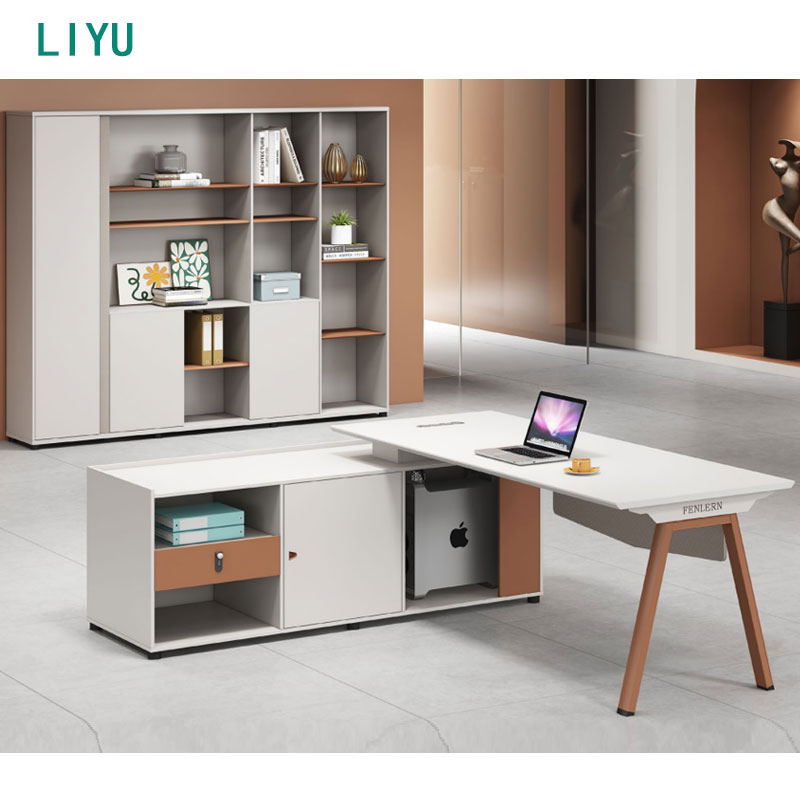
Specific material pairings must hold up to daily operational wear, environmental factors, and indoor air quality standards. Evaluating these dimensions ensures the aesthetic appeal does not degrade prematurely. A desk that looks stunning on day one but shows uneven wear by year two represents a failure in material specification. Performance dictates the final finish selection.
High-Pressure Laminate tops drastically outperform polyurethane-coated wood veneers in standard Taber abrasion resistance tests. The Taber test involves mounting a material sample on a turntable and subjecting it to the rubbing action of two abrasive wheels. HPL typically withstands over 400 cycles before showing wear, whereas standard wood veneers might show degradation at 100 cycles. When designing a two-tone workstation, placing the highly durable HPL on the primary work surface prevents uneven wear patterns. If a high-touch surface degrades faster than the secondary decorative finish, the entire unit looks dilapidated.
We follow a strict protocol for evaluating wear resistance on mixed materials:
Natural wood finishes amber or fade at different rates compared to synthetic laminates when exposed to direct sunlight. A natural cherry veneer shifts in color over time due to photochemical reactions in the wood's lignin. A synthetic black laminate remains completely unchanged. This differential fading alters the intended contrast ratio of the desk.
To mitigate this, specify UV-cured topcoats for all natural wood components. These specialized inhibitors stabilize the color and block harmful ultraviolet rays. They preserve the original design intent regardless of window placement. We also recommend rotating desk accessories periodically during the first six months to prevent shadowing on natural wood surfaces.
The transition zone between two tones is the highest risk area for moisture ingress and delamination. Spilled liquids, cleaning solutions, or high ambient humidity exploit weak seams. This causes the underlying substrate to swell and destroy the surface finish.
For high-traffic environments, 2mm PVC or ABS edge banding applied with moisture-resistant PUR (polyurethane) adhesives is an absolute requirement. Standard EVA glues degrade over time and reactivate under heat. This leads to catastrophic edge failure. PUR adhesives cure through a chemical reaction with moisture in the air, rather than just cooling down like traditional hot-melt glues. This cross-linking process creates a waterproof bond that cannot be reactivated by heat.
Off-gassing risks vary significantly between painted MDF and natural oils or water-based sealants. When specifying a mixed-material desk, verify that all components comply with rigorous green building certifications like GREENGUARD Gold.
Water-based topcoats on natural wood minimize volatile organic compounds (VOCs). This ensures healthy indoor air quality for enclosed office spaces. Solvent-based paints on contrasting panels can emit harmful chemicals for months after installation. Demanding low-VOC certifications for both finishes in a two-tone setup protects user health and safety.
Analyzing the financial implications of specifying mixed-material furniture requires looking beyond the initial acquisition. Value is determined by material longevity, manufacturing complexity, and the strategic deployment of premium finishes. A well-engineered two-tone desk maximizes aesthetic return while minimizing unnecessary expenditure on hidden structural components.
The cost delta between a fully solid wood workstation and a strategically engineered desk utilizing TFL chassis and HPL tops is substantial. Two-tone designs optimize procurement budgets by utilizing premium materials only on high-visibility surfaces.
You can specify high-grade wood veneer for the guest-facing modesty panel and desktop. You then utilize highly durable TFL for the internal storage pedestals and structural returns. This value engineering approach delivers a premium look and superior durability without inflating the overall project budget.
Custom two-tone configurations often bypass standard quick-ship programs. This extends procurement timelines by four to eight weeks. Sourcing two distinct materials for a single unit introduces complex supply chain variables. If the metal base manufacturer experiences delays, the entire desk assembly stalls.
Planners must build these extended lead times into their project schedules to avoid operational disruptions. Standardizing finish combinations across a floor plan helps mitigate some of these manufacturing bottlenecks. We advise ordering a mock-up unit early in the project timeline to verify material compatibility before full-scale production begins.
The aesthetic longevity of two-tone designs directly impacts future redeployment value. Balancing trendy, high-contrast colors with timeless neutral pairings ensures the furniture remains relevant across multiple office redesigns.
Contrasting open and closed storage units, such as pedestals and credenzas, offer high modularity. These individual components can be swapped, upgraded, or repurposed independently without replacing the entire desk structure. This modular approach maximizes the return on the initial furniture investment. It provides flexibility as organizational needs evolve.
Actionable steps taken before issuing a purchase order prevent costly specification errors. Mixed-material desks require tighter quality control and more rigorous vendor vetting than standard single-finish furniture. Overlooking the technical details of how two materials join, match, and function together results in premature failure.
Matching wood grain stains across different production runs is notoriously difficult. Natural variations in the timber and subtle shifts in dye lots cause discrepancies. If you plan to expand the office footprint later, a desk ordered two years from now may not match the original batch. This creates a disjointed aesthetic.
To mitigate this risk, order attic stock during the initial procurement phase. Alternatively, require the manufacturer to guarantee finish matching for a specified multi-year period. Using synthetic laminates for the colored portions of the desk is another effective strategy. They offer perfect batch-to-batch consistency.
Routing cables cleanly through contrasting panels without disrupting the visual design is a common challenge. The placement of grommets, power modules, and wire management trays must be carefully evaluated.
Ensure their finishes coordinate perfectly with the dual-tone scheme. For example, specify matte black hardware on a black and walnut desk to maintain a cohesive aesthetic. Mismatched silver grommets on a dark chassis immediately cheapen the look. They draw unwanted attention to the cabling infrastructure. We recommend specifying under-desk cable troughs that match the chassis color exactly.
Manufacturers sometimes offer warranties that cover the structural chassis for ten years but limit the surface finish warranty to just one or two years. This is a significant risk for dual-finish desks where the surface is subjected to heavy daily wear.
Demand comprehensive, single-source warranties that cover delamination, fading, and finish degradation equally across both tones. Verify that edge banding failure is explicitly covered under the structural guarantee. This is the most common point of failure in mixed-material furniture.
A: They do not inherently wear faster. However, contrasting edges can highlight chips or scratches if the underlying substrate color differs significantly from the surface finish. High-quality edge banding and durable topcoats prevent visible degradation along the transition seams.
A: The most durable combination pairs a High-Pressure Laminate (HPL) work surface with a powder-coated steel or Thermally Fused Laminate (TFL) base. This ensures maximum scratch resistance on the top and structural stability below, making it ideal for heavy daily use.
A: Yes. Utilizing lighter tones, such as soft grays or warm whites, for the upper portions of the desk increases light reflectance. Pairing this with a darker base grounds the furniture, creating a visual illusion of more open space in a compact room.
A: Maintenance depends on the specific materials. Use a damp microfiber cloth with mild soap for laminate or metal parts. For natural wood or veneer sections, avoid harsh chemicals. Use a dedicated wood cleaner to protect the topcoat and prevent the grain from drying out.
A: Edge banding seals the transition seam between two different finishes. This is the highest risk area for moisture ingress and delamination. Utilizing 2mm PVC or ABS banding with PUR adhesive prevents peeling and ensures the desk withstands high-traffic environments.
A: Specify grommets and power modules that match the specific zone where they are installed. Use matte black hardware on dark chassis sections and white or silver hardware on lighter surfaces to keep the cabling infrastructure visually integrated.


