
Views: 0 Author: Site Editor Publish Time: 2026-09-20 Origin: Site


An executive workspace operates as a high-performance tool rather than a mere visual statement. The desk serves as the operational command center for daily decision-making, confidential document reviews, and establishing leadership presence. Many high-end desks prioritize superficial aesthetics over the functional realities of executive workflows. Buyers often face a frustrating disconnect between a desk's visual appeal and its actual ability to handle integrated technology, prolonged ergonomic use, and secure storage. Selecting the right piece requires moving far beyond basic dimensions and surface finishes. This guide provides a technical evaluation framework for assessing material integrity, craftsmanship, workflow support, and architectural presence. Applying these criteria ensures the chosen desk delivers measurable improvements in executive productivity, physical comfort, and daily operational efficiency.
A successful executive workspace must seamlessly blend authoritative presence with frictionless daily utility. Standard premium furniture often looks impressive in a showroom but fails under the rigorous physical and technical demands of daily executive use. True luxury anticipates the user's operational needs, offering a tailored environment that enhances focus and facilitates communication without requiring workarounds.
When evaluating a CEO office desk, you must analyze its dual function. First, it acts as a private workstation for deep, focused work requiring multiple monitors, reference documents, and secure hardware. Second, it serves as a public-facing anchor for one-on-one meetings, interviews, and negotiations. Standard premium desks frequently fail in both areas simultaneously. They suffer from visible cable clutter when IT teams are forced to retrofit power strips. They lack secure document storage, relying on easily bypassed wafer locks. They also exhibit poor acoustic dampening, causing keyboard strikes to echo during conference calls.
The baseline requirement is absolute adaptability. The desk must adapt to the executive's specific operational style. If an executive frequently reviews oversized architectural blueprints or financial ledgers, the surface area must accommodate them without requiring the user to shift monitors or keyboards. If they host continuous back-to-back meetings, the desk must offer an inviting approach for guests, providing adequate knee clearance rather than acting as a physical barricade.
Evaluating high-end furniture requires a critical eye for structural details and material science. You must look past the initial visual impact and assess how the materials, joinery, and finishes will perform over years of heavy, continuous use.
Achieving true office desk luxury requires evaluating the functional outcomes of material choices. A refined mix of warm wood tones and premium full-grain leather inlay pads provides excellent acoustic dampening. This combination absorbs the clatter of keyboards and softens the sound of metal pens or phones being placed on the surface. Leather also offers superior thermal comfort, remaining neutral to the touch regardless of the room's HVAC settings. High-gloss veneers or tempered glass offer high durability and striking reflective properties, but they feel physically cold, show fingerprints instantly, and amplify ambient noise.
Structural requirements vary based on the chosen materials. Solid timber offers unmatched longevity but reacts to humidity changes, potentially warping over time. High-grade engineered MDF cores wrapped in thick, commercial-grade veneers (typically 1mm to 2mm thick) provide superior dimensional stability. These engineered cores resist bowing under the sustained weight of heavy multi-monitor setups and desktop hardware.
Flawless joinery, sleek lines, and bespoke detailing indicate superior build quality. Look for dovetail joints in drawer boxes, perfectly matched wood grain patterns that flow continuously across seams, and edge banding that feels smooth and substantial. Drawers should utilize heavy-duty, concealed undermount slides capable of supporting 100 pounds of paper without sagging or sticking.
The desk's silhouette fundamentally impacts room dynamics. Closed-modesty panels create an authoritative, grounded presence. They hide the user's legs, wastebaskets, and any under-desk hardware, establishing a clear, formal boundary between the executive and the guest. Floating-top designs with open metal bases foster a collaborative, transparent feel, making the room appear larger and less imposing, though they require absolute discipline regarding under-desk clutter.
You must evaluate the desk's footprint relative to the required clearances in the room. A massive desk loses its appeal if it traps the executive against the back wall or leaves insufficient room for comfortable guest seating. Proper spatial efficiency ensures enough clearance for the executive to rotate their chair fully, access rear credenzas, and allow guests to approach without feeling cramped.
The desk anchors the broader room design. It must coordinate seamlessly with impactful meeting tables and built-in wall storage systems. A cohesive environment requires matching wood stains, complementary metal hardware finishes, and aligned architectural lines across all furniture pieces in the room.
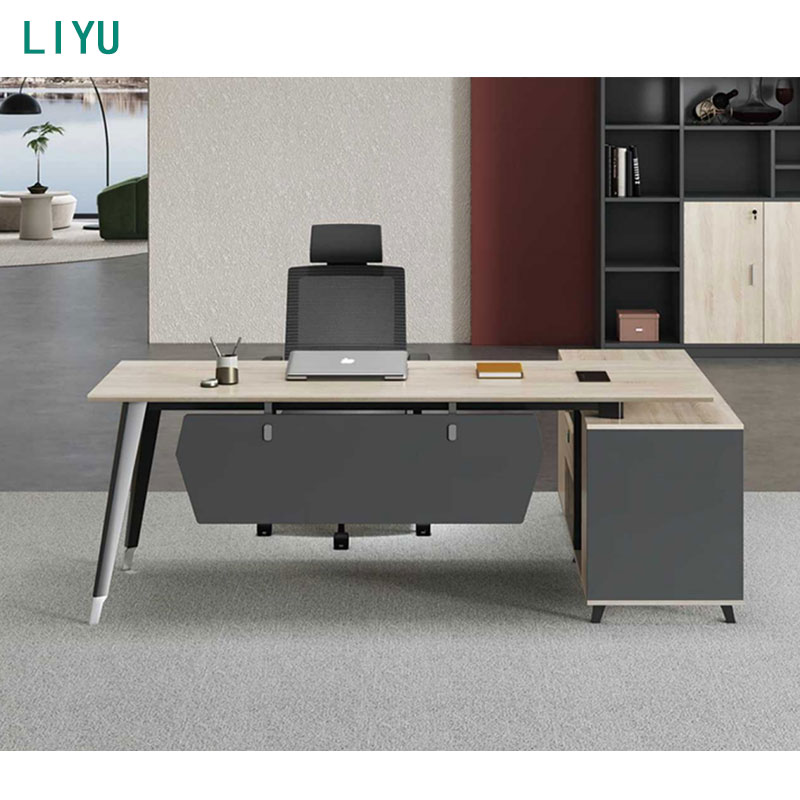
Aesthetics draw the eye, but functional details sustain daily productivity. High-end desks must incorporate modern technology, power distribution, and ergonomic support without sacrificing their visual appeal or architectural integrity.
A high-performance luxury executive desk demands completely concealed power distribution. Exposed wires instantly ruin the aesthetic of a premium workspace. Look for integrated cable troughs that run the entire length of the desk beneath the surface. Flush-mounted power and data grommets should blend seamlessly into the surface material, featuring soft-close lids matching the desk's veneer or metal finish.
Wire-management channels must be routed internally through the desk legs. This allows cables to travel from the floor core directly into the desk without ever being visible. Ease of access is equally important. IT teams must be able to update hardware, swap out data lines, or troubleshoot connections quickly. Magnetic access panels and drop-down cable trays provide this necessary accessibility, allowing technicians to work without dismantling the workspace or disrupting the desk's sleek lines.
Integrating ergonomics into high-end aesthetics presents a significant design challenge. Traditional executive desks often force users into static, unhealthy postures. Modern luxury requires dynamic movement without looking like an industrial workbench.
Evaluate concealed dual-motor sit-stand mechanisms. The best systems maintain a static, architectural look when lowered. They hide the telescoping lifting columns within traditional pedestal bases or thick wooden leg structures. When activated, they offer health benefits and dynamic movement during prolonged work sessions. The motors should operate silently (under 50 decibels) and feature gyroscopic collision detection to prevent the desk from crushing under-desk cabinets or damaging the motors if an obstruction is hit.
Executives handle sensitive information, proprietary data, and confidential personnel files daily. Built-in storage solutions must be tailored to these specific security needs. Standard key locks are easily compromised and no longer sufficient for high-level confidentiality.
Executive desks fall into several distinct categories. Each profile serves a specific type of workflow, industry expectation, and architectural environment. Understanding these categories helps narrow down the selection process based on actual operational needs.
Selecting a modern white office desk brings a minimalist, high-contrast profile to the workspace. These desks often utilize metal, glass, or matte-lacquered finishes with sleek, geometric lines. They reject heavy ornamentation in favor of stark, clean surfaces that reflect natural light.
This profile fits tech-forward executives, creative directors, and spaces designed for high collaboration and transparency. The bright surfaces make the office feel energetic and expansive, aligning well with modern glass-walled office architecture.
This style requires rigorous cable management. Minimalist designs offer fewer places to hide hardware, bulky power bricks, and thick data cables. It demands high-quality, stain-resistant finishes to keep surfaces pristine. Matte lacquers must resist fingerprints, and white high-pressure laminates must reject ink, coffee stains, and scuff marks from daily use.
The classical heavy-timber desk features traditional U-shape or L-shape configurations. It showcases rich wood grains like mahogany, walnut, or cherry, integrated modesty panels, and extensive pedestal storage. These desks project permanence, stability, and historical authority.
This profile fits legal, financial, and traditional corporate sectors. These industries require maximum authority, timeless elegance, and high-volume physical document storage. The extensive drawer space accommodates physical files, reference books, and office supplies easily, keeping the main work surface clear.
The primary trade-off is the heavy visual and physical footprint. These desks can make a space feel constrained if not properly scaled to the room. They are exceptionally heavy, difficult to move, and often require custom retrofitting to handle modern multi-monitor setups and extensive power routing.
The hybrid executive console consists of modular systems combining a height-adjustable main work surface with a static, low-profile credenza. This creates an L-shaped or T-shaped configuration that separates the active computer workspace from the storage and meeting areas.
This profile fits dynamic workflows requiring frequent shifts between solo computer work and impromptu team huddles. The executive can stand at the main desk for focused tasks and move to the static credenza to review physical documents with a colleague or host a brief meeting.
The trade-offs include higher mechanical complexity. The sit-stand components require dedicated power and future maintenance. It requires careful spatial planning to ensure moving parts do not clash with surrounding architecture, window mullions, or built-in wall storage when the desk is raised to its maximum height.
| Desk Profile | Best Suited For | Key Advantage | Cable Management Difficulty | Physical Footprint |
|---|---|---|---|---|
| Modern White Minimalist | Tech, Creative, Modern Corporate | High-contrast, light-enhancing aesthetic | High (Few places to hide bulky hardware) | Light to Medium |
| Classical Heavy-Timber | Legal, Finance, Traditional Corporate | Maximum authority and physical storage | Medium (Requires retrofitting for modern tech) | Heavy / Expansive |
| Hybrid Executive Console | Dynamic, Agile Workflows | Combines ergonomics with expansive surface area | High (Must route cables through moving parts) | Medium to Heavy |
Procuring a high-end desk involves balancing competing priorities. You must weigh the desire for a stunning visual centerpiece against the practical requirements of daily executive tasks, maintenance, and long-term durability.
You must analyze the compromise between a visually striking statement piece and practical utility. A highly sculptural desk with angled edges and a thin glass top looks incredible in architectural photographs. However, it often fails in practice. Thin edges cannot support clamp-on monitor arms. Glass surfaces show every fingerprint, dust particle, and wire beneath them. Angled bases can restrict legroom and prevent the use of ergonomic under-desk footrests or mobile pedestal files.
Highly customized, sculptural desks often lack the modularity required for future technology upgrades. If a desk features a custom-routed cutout for a specific brand of power module, changing that module in five years when connection standards change becomes nearly impossible. You must ensure the desk accommodates standard task lighting, universal monitor mounts, and easily upgradable power distribution units.
Evaluate the physical durability and long-term support for the furniture. High-end furniture requires specialized handling. Factor in the logistics of freight and white-glove installation. Large, solid-wood desks or expansive stone-topped consoles may not fit into standard commercial elevators, requiring costly stair carries, window removals, or crane hoists.
Review the warranty coverage on mechanical parts, especially for sit-stand models. Motors, control boxes, and memory switches have shorter lifespans than solid wood or steel frames. Ensure the manufacturer guarantees replacement parts for at least ten years to prevent the desk from becoming obsolete due to a single failed motor.
Consider the availability of matching casegoods. An executive office rarely contains just a desk. You will need matching credenzas, bookcases, lateral files, and meeting tables. Ensure the manufacturer offers a comprehensive, long-running collection to maintain aesthetic consistency as the office expands or requires additional storage.
Even the finest desk will fail if it does not integrate properly into the physical room. Executive office design carries specific implementation risks regarding spatial planning and technology integration that require proactive mitigation before procurement.
A common risk is ordering a desk that overwhelms the room. A massive desk can clash with built-in wall storage, preventing cabinet doors from opening fully. It can obstruct natural light from floor-to-ceiling windows and disrupt the natural traffic flow for guests entering the space, making the office feel cramped rather than luxurious.
Mitigation requires strict spatial planning protocols on site.
Another major risk involves power routing. The desk arrives, but the room's floor-core power outlets do not align with the desk's cable entry points. This misalignment leads to exposed wires stretching across the carpet, creating tripping hazards and instantly ruining the luxury aesthetic.
Mitigation requires early coordination. Conduct a pre-purchase site survey with IT and facilities management. Map the exact locations of power and data access points against the desk's structural schematics. If the floor core does not align with the desk's hollow leg or cable trough, you must either core a new hole in the concrete floor, trench the floor, or select a different desk design. Do not rely on extension cords or plastic wire covers in an executive space.
A: A true luxury executive desk combines premium materials, flawless joinery, ergonomic intelligence, and integrated technology management. It moves beyond just brand name or price tag to actively support how an executive works, offering acoustic dampening, secure storage, and a commanding architectural presence without compromising daily utility.
A: Cable management relies on built-in cable troughs, hollow routed legs, and flush-mounted grommets. By aligning the desk's internal wire channels directly over floor-core power outlets, IT teams can keep wires entirely invisible from the floor to the desktop while maintaining the desk's sleek, architectural lines.
A: Yes, provided it utilizes high-quality, stain-resistant laminates or catalyzed matte lacquers. It suits paperless, tech-heavy workflows perfectly. However, it requires rigorous maintenance to prevent fingerprint buildup and demands exceptional cable management due to its minimalist, open design.
A: Absolutely. Many premium desks feature concealed dual-motor systems and hybrid credenza setups. These mechanisms offer full height adjustability for ergonomic health without looking like standard utilitarian office furniture, keeping the lifting columns hidden within thick architectural bases or traditional pedestals.
A: Tempered glass and high-pressure commercial laminates offer the highest scratch resistance. Solid wood and premium full-grain leather inlays provide superior tactile luxury, thermal comfort, and acoustic dampening, though they require more careful maintenance to prevent dents and liquid stains.
A: Industry standards dictate a minimum of 42 to 48 inches of clearance behind the desk. This space allows the executive to comfortably push their chair back, rotate freely, and access rear credenzas or built-in wall storage systems without feeling cramped or damaging the walls.


